316 Superbike Camp Day 1 Priorities: What Coaches Teach New Track Riders First
Beginners show up with the same two things in their helmet.
A head full of highlight reels and hands tight enough to bend the clip-ons.
I’ve watched it over and over: the bike is fine, the tires are fine, the weather’s fine – but the rider is wound up like it’s a qualifying lap. During the recent 316 coaches clinic, I asked six of our coaches a simple question: if you only had half a day with a brand-new track rider, what do you prioritize first – and why?
None of them went straight to fancy techniques. The answers kept circling the same idea: calm the rider down, give them a simple plan, and make them repeatable enough that coaching can actually stick.
TrackDNA safety note: This isn’t personal coaching or medical advice. It’s a snapshot of what these coaches prioritize for most new riders on Day 1. Your pace, your bike, your track, and your track organization’s rules matter. When in doubt, ride within your limits and follow your track organization’s protocols.
“Day 1 isn’t about lap times. It’s about creating a rider who can function inside the system without turning every lap into chaos.”
The real Day 1 goal: safe, calm, coachable
If you strip all six answers down, Day 1 isn’t about lap times. It’s about creating a rider who can function inside the system without turning every lap into chaos.
That usually looks like this: they can get on and off track cleanly, they understand basic signals, they’re not death-gripping the bars, and they’re riding a line you can predict from half a lap away. Once that base exists, the day stops feeling like survival and starts feeling like learning.
You can see it when it clicks. Their shoulders drop. The bike settles. And suddenly the rider has enough spare attention to actually notice what’s happening.
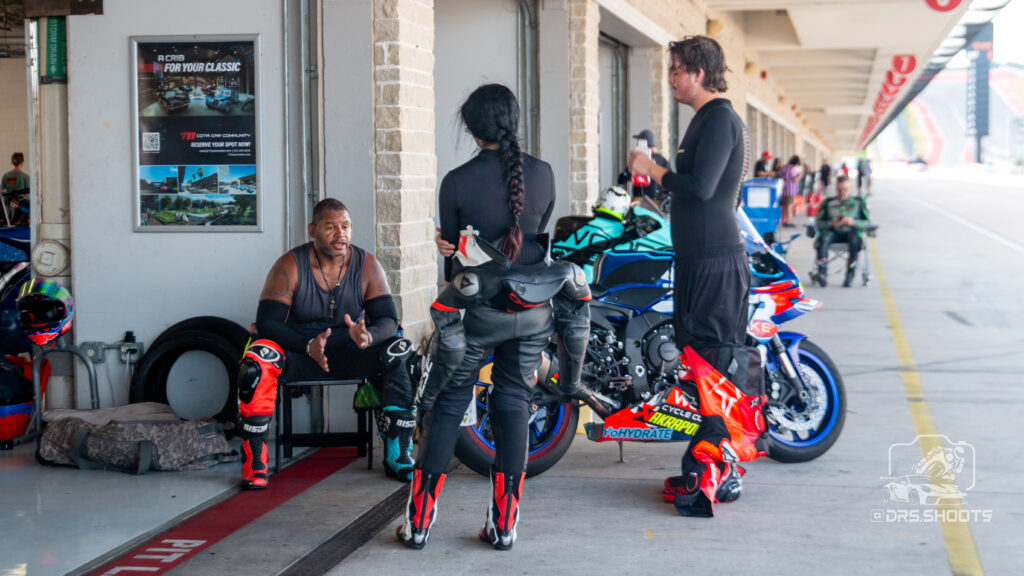
316 COTA Track day Sep 2025 – Damien Kimbrough and his students between the sessions | Photos by David Schwartz
What each coach prioritizes first
Damien Kimbrough – Relaxation first, because it unlocks vision
Damien starts with comfort on the motorcycle. Not “perfect body position.” Not “hang off harder.” Just comfortable enough that the rider stops riding like the bike is trying to throw them off.
He sees a lot of street riders show up tense and restrictive. As they relax lap by lap, their vision improves without anyone yelling “look farther.” They finally have the bandwidth to observe what’s around them, and that’s where safety starts to improve fast.
His early focus is calm body, calm breathing, and eyes that can finally do their job.
Paul Carter – race line, relax, vision – repeat until it lands
Paul wants Day 1 clean and uncluttered. Give the rider a simple race line they can repeat, then layer in relaxation and vision without turning it into a mental pile-up.
He calls out something that’s painfully common: street riders often don’t look far enough ahead, and even when they try, they “forget everything in between.” He’s coaching continuity – seeing the whole corner as a sequence instead of fixating on one point.
And he’s big on repetition. Same message, over and over, until it becomes usable at speed.
Marquis Davis – Body position, but only if it passes the SCCF test
Marquis is the outlier because he starts with body position, but not in a “copy MotoGP” way.
He uses SCCF: Safe, Comfortable, Cool, Fast. Safe is non-negotiable. Comfortable comes next, because discomfort turns into tension, and tension turns into bad inputs. Cool is the hook because riders care how they look, even if they pretend they don’t. Fast comes last, because speed shows up when the first three are true.
He ties line choice and track position back to making an early decision. Pick your position early. Don’t realize mid-corner you should’ve been somewhere else and try to fix it late. Late fixes are where riders get unpredictable – and unpredictability is what puts everyone on edge.
He also stresses reference points. Learn the track so it stops feeling like a blur, and your choices start making sense.
Robert Franklin (Sarge) – Calm the nerves, fix the death grip, lock in the line
Sarge starts with the emotional side, because Day 1 anxiety is real. Especially for riders who grew up watching MotoGP and show up feeling like they’re about to go do that.
His first job is to calm them down.
Then he goes straight for the death grip. Light hands. Stop strangling the bars. Let the bike do what it’s built to do instead of muscling it through every input.
From there he goes to the line – not because it’s “the fastest,” but because it makes the rider predictable. He adds a fair nuance: it’s not only the beginner’s responsibility to manage traffic, but predictability still matters in a mixed group. It’s part of being safe.
Chris DeLanghe – Signals and predictability create something you can coach
Chris starts with communication: signals and track procedures, the basic language that keeps everyone working together out there.
Then he leans hard on predictability. He says something new riders don’t always want to hear: even if you’re “wrong,” if you’re wrong in the same place every lap, you’ve given a coach something to work with. Consistency is the foundation. Without it, every correction is just a guess.
From there he can use video, show “where you were vs where you need to be,” send the rider back out, and let them feel the difference. Once a rider feels it once, the rest of the day gets easier – and a lot more fun.
Robert Bernal – Pit flow and track orientation before anything else
Robert goes straight to the stuff nobody makes a cool reel about: pit-out, pit-in, track entry and exit, and orientation.
His point is blunt – if you don’t know where you’re going, you can’t be safe. A lost rider gets unpredictable fast, and unpredictability is what turns normal traffic into close calls.
He also builds in a check by noon. See where the rider really is, adjust the plan, and keep the focus on fundamentals that prevent messes.

From the Paddock to Your Inbox
Subscribe to our newsletter for new stories, issue updates, and paddock news.
The shared 316 Day 1 blueprint
Across all six coaches, the overlap is pretty loud.
Relaxation shows up first – calm brain, calm hands, calm breathing. Then the “system” pieces show up: signals, pit flow, knowing where you are and where you’re going. After that comes a simple line and basic track position you can repeat.
Body position is in there too, but mostly in the practical sense – loose upper body, light hands, don’t fight the bike – not as a hanging-off contest.
The through-line is repeatability. If a rider can do the same thing every lap, the coach can help them do a better version of it.
“Predictability beats perfection for beginners because it gives coaches something to build on.”
A half-day plan that matches how these coaches think
Session 1 – Remove chaos
Start with pit procedures, on/off track basics, and signals. Give the rider one riding goal: relaxed hands and eyes up. No experimenting. No “sending it.” Just stable laps where the rider isn’t overwhelmed.
Session 2 – Orientation and reference points
Pick a small number of reference points – usually a turn-in point and an exit point – and commit to looking far enough ahead to connect the “in-between.” If the rider is consistent but not perfect, that’s a win. Perfect isn’t the goal yet.
Session 3 – Lock a simple line and make it repeatable
Establish a basic line that’s appropriate for their group and pace, and stick to it. The coach picks one correction, not ten. The rider’s job is to apply one change and feel what it does.
By noon – Quick reset check
Are they calmer than they were this morning? Do they understand signals and pit flow? Are they riding a repeatable line? If yes, they’ve earned the right to add one more layer in the afternoon.
What Day 1 is not
Day 1 usually isn’t the day to overload a brand-new rider with advanced body position, deep trail braking, or lap-time chasing. Those things matter later, and a good coach will absolutely build toward them.
But when a rider is still tense, still getting lost, and still inconsistent, “more technique” just becomes noise. The real win is building the rider you can actually teach on Day 2.
“Once that base exists, the day stops feeling like survival and starts feeling like learning.”
TrackDNA Takeaways
- Calm hands and calm breathing are performance tools, not just comfort cues.
- Predictability beats perfection for beginners because it gives coaches something to build on.
- Reference points are the bridge between “surviving laps” and actually learning.
- A simple line repeated well is safer than a “better line” ridden inconsistently.
- Once a rider feels the difference one time, they’ll chase that feeling the rest of the day – in a good way.
Session Notes
- Session note #1: Where did you notice your hands getting tight today? What did you do on the next straight to fix it?
- Session note #2: Pick one corner. What were your two reference points (turn-in and exit)? Did you hit them three laps in a row?
One question to ask yourself after the day
Where did I still feel rushed – and was it because I was late on my eyes, late on my setup, or just riding tighter than I thought?
Issue 01 is
Out Now
TrackDNA Issue 01 is a 124-page premium, community-driven magazine for motorcycle track riders & enthusiasts.
Author
-
Sean Beenaam is the founder and Editor-in-Chief of TrackDNA, a media brand dedicated to the culture, craft, and community behind motorcycle track riding. Created to feel like the paddock itself - welcoming, unfiltered, and rooted in real experience - TrackDNA gives space to the stories and voices that often get overlooked.
A published author and active CMRA racer, Sean brings a rider-first lens to the work, building a magazine shaped by the people, lessons, and culture that keep riders coming back to the track.