Preseason Motorcycle Maintenance – Chassis and Suspension Review by Dave Moss

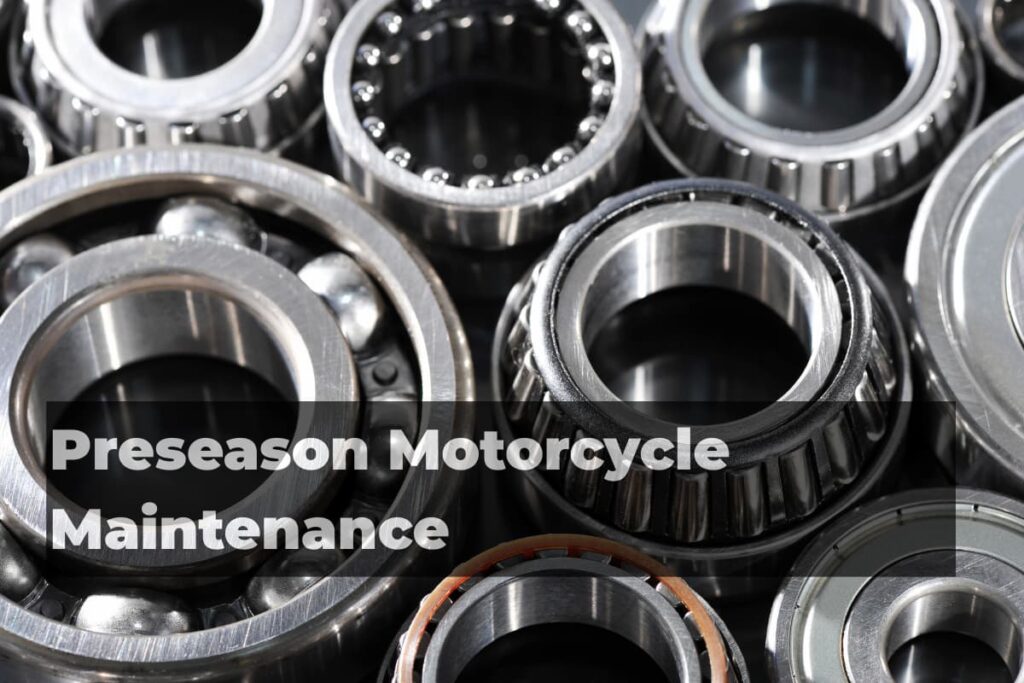
a group of different type bearings

If you have an annual practice of draining the tank to winterize your motorcycle and walk away for 3-5 months due to a seemingly interminable winter and a ludicrously short riding season, this article will provide a perspective that encourages you to revisit your motorcycle over the winter months for a task per month to complete. This of course is entirely dependent on your storage space, tool selection, available time, and your comfort in getting these tasks completed. The added bonus is that you get quiet time with your motorcycle to get you out of the house, domestic and/or work and life stress, as well as the opportunity to feel good about a task completed well AND correctly!

The faster you ride, the more maintenance you MUST do. This is a non-negotiable.

Chassis maintenance

Grease has a “dropping point” in respect to temperature where once reached, the grease will change state from a semi-solid to a liquid and therefore actually melt and consequently dribble and spread out where access is granted. Dropping point is one useful indicator when choosing grease, but it is not the only factor. There are several locations on your motorcycle that can show you visual evidence of this:

  • Lower triple clamp junction with the steering head
  • Upper steering frame and head bearing area
  • Engine mounts
  • Swing arm bolt/swing arm
  • Shock linkage
  • Rear wheel cush drive
  • Front and rear wheel bearings

If you see large accumulations of dust in these locations and you are unsure of the how and why the dust and debris are there, now you know…

This type of chassis maintenance is an annual task for weekend use motorcycles, a twice-yearly task for commuting motorcycles, and three times a year for track motorcycles that are used on track for 20 days or more. For top tier racers attempting to secure a #1 plate for their State or region, inspection should be every other race event.

Have you ever taken the time to touch the frame when you stop after a track practice session? Have you come into contact with the frame accidentally after a 20 minute practice or a race? Did this happen one time as it burned your fingertips, hand or forearms? Since then, you have steered clear of this area? (pun intended…). Frames often reach 100C or 212F. Localized temps near the steering head and engine area can exceed what your hands feel on the frame.

What grease should be used? Look at high temperature wheel bearing grease and find the highest dropping point you can at or beyond 550F or 288C.

Steering head bearings

As a general rule when inspecting bearings, feel the movement of the bearing. If it is very smooth, chances are the bearing and race are good. If not, replace them.

Tension on your steering head bearings is critical for braking stability. This adjustment is a key factor in avoiding the dreaded “clunk” of the steering head bearing bashing into the top, bottom races when braking occurs. Not only is the bearing stressed during this movement, it can also hammer itself into the race and over time – create a bearing race that resembles a West Indian steel drum. I’ve seen far too many of those damaged races over three decades of work and it is far more common than you think.

On any stock motorcycle for the steering head, you may find loose ball bearings (absolute nightmare), ball bearings embedded in a cast plastic ring, or tapered roller bearings. No matter what you find, there is an optimal amount of grease that should be used. Use too much and the tension on these bearings will be incorrect as the grease cushion creates a false torque number. Too little and the grease will melt quickly and yes, you will be doing the job again long before it is due.

No matter what you find as bearings, you need to remove the parts and clean them thoroughly. No excuses, get the job done right and remove every bit of the grease you find from the frame, races, steering stem and bearings and surrounding area. Take your time and be meticulous when cleaning to develop a best practice in excellent job completion. No shortcuts, just pride in your work and a job well done.

Once the steering head is clean, install the bearings that have been greased correctly and set the torque value on the bearings via the lock rings or other mechanical piece.

Wheel bearings and cush drive

The next task is to inspect your front and rear wheel bearings. As brake rotors can reach 500F or 260C as an average, the same issues can be seen with these components. Upon inspection, do you have the same dust and debris around the outside edges of each bearing on the front wheel? When you remove the rear wheel and separate the cush drive, do you see the same dust and debris inside it? Are the wheel bearings sealed with a protective cover that cannot be removed? Does the cover come off so you can see what grease is present?

If the bearing is a sealed cartridge type, replace it – don’t try to repack it. If you can access the bearings, the same meticulous cleaning procedure is required. You can use too much or too little grease, so if in doubt, be thorough, not excessive, as once the dust seal is replaced (where applicable), a small amount of excess grease should ooze out. When the wheel is replaced and torqued correctly, there may be some more excess grease so clean it all up correctly.

Get the Inside Line

Real stories, track insights, and paddock moments — straight from riders who live it. No noise, no fluff, just the DNA of the track delivered to your inbox.

Swing arm axle and shock linkage

Next task is the removal of the swing arm axle and rear shock with linkage components. This may require special tools so assess what you need before you start to make sure all tools are on hand! Swing arm axles generally have very little grease from the Factory, so be prepared to acquire some help from a third party item to encourage it to exit from its location. Inspect the bearing on each side of the swing arm and determine if they are sealed or open. This will show you what you can or cannot do. Inspect the swing arm axle for corrosion or adverse wear and assess its viability for the coming season. There is nothing wrong with a small amount of grease or oil on the axle to ease installation.

When you reinstall the swing arm axle and torque it in place, assess side to side play by moving the swing arm left to right in the horizontal axis. Assess free play vertically and then push down on the left side and push up on the right and reverse this action to assess torsional free play.

If all is well, inspect and clean every part of the shock linkage and examine all bearings to see what is sealed or open, all plain bushings, bolts and nuts. A wire wheel is great for cleaning bolts!

Reinstall the shock and components to the correct torque settings and assess free play in the bushings by gently lifting the end of the swing arm vertically.

Knowing that your chassis is 100% perfect is a huge confidence booster when you go out for the first practice day.

Suspension

There are several points of view on maintenance for these components (forks, shocks and steering dampers) that often create contention, angst or polarize riders. Personally, I will always honor the manufacturer’s schedule whether that be hours, events or an odometer reading. They have servicing intervals all figured out so don’t try to reinvent the wheel. When asked for my opinion, I will always encourage the individual to leverage perspective: what is your ability, how long since the last service, how many track days do you intend to do, will you race this year, what are your lap time goals, how consistent do you want the viscosity to be when you block pass at lean while trail braking at close to maximum grip levels? A rider’s honesty is critical and if I feel I’m not getting it, I will try a more direct approach.

The slower the rider, the less stress they place on the suspension so the oil does not get the same amount of abuse as it would from a lap record holder. Therefore, perspective would suggest that the interval can be longer within the manufacturer’s limits, or shorter for harder use due to the ability of the rider and their lap times. With that perspective, there is also a maximum time that I would communicate to the rider that is a hard and fast number that they cannot go beyond as they are encouraging risk, whichever comes first.

Why?

Oil has an engineered viscosity delta between hot and cold. The newer the oil the more consistent flow rate is when on track. That’s why we always reference cSt (centistoke ranges) for race bikes and viscosity index for track bikes as a starting point. This is critical information as we depend upon front end feel and consistent grip due to stable fork oil viscosity and flow when at operating temperature. I’ve seen far too many riders using fork oil well past the service time in race bikes to save money and when I extract something that resembles very tacky gel and the smell of ammonia erupts when they unscrew the fork cap, this is a one-time message that hits home very hard. Most of us know what a Lava Lamp is – does your suspension oil fit this description?

You should be very diligent in regards to fork seal rubber compliance and potential stiction. There are many brands to choose from, so I always refer to OEM as a “go to” for track-day riders. For racers, there are other options like SKF that offer a lot less friction/stiction to OEM.

Many racers remove the dust seal for less stiction, yet that dust seal is the first of two “scrapers” to clean the fork tube. A zero barrier means that the oil seal is vulnerable, so are you prepared to keep the fork tubes clean between sessions, between days, between events?

For race bikes, compression and rebound valving, pistons and flow control needles need to be inspected mid season for dirt and debris. For those chasing a Championship or riding at the National level, this may be more frequent as valving is changed based on circuit design (tight and technical vs fast and flowing), so there may be very specific valving and spring rates per track.

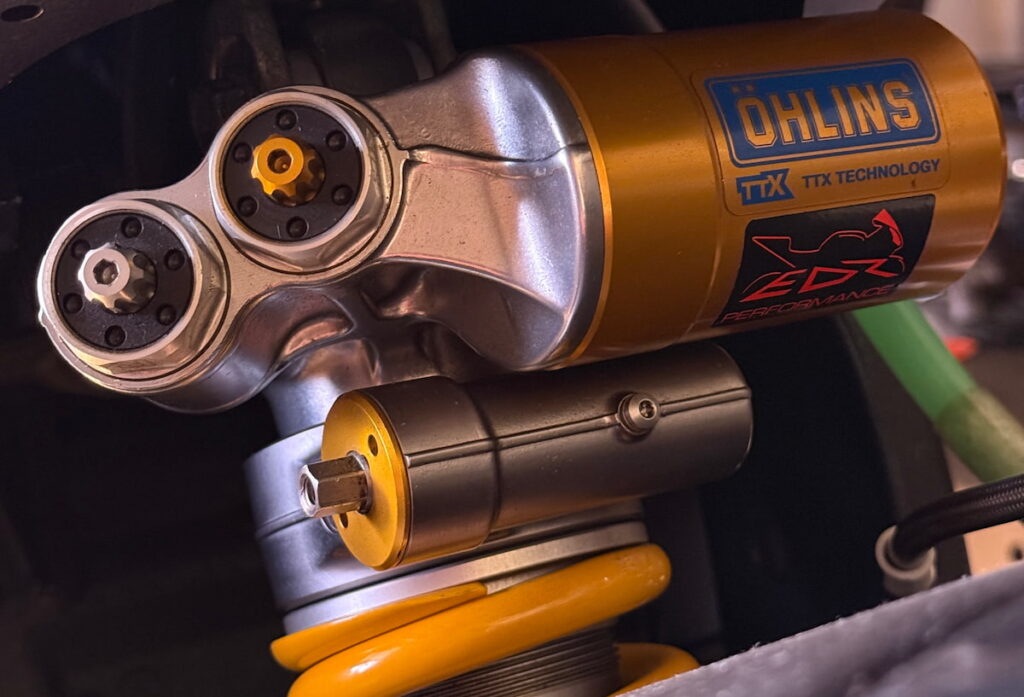
Many rear shocks are heated by the engine and in some models, sit right next to the exhaust where it exits the cylinder head. How much heat is transferred to the down pipe exiting the exhaust port(s)? The average is 600 to 1,000C or 1,100 to 1,800F. How quickly will this oil deteriorate from just heat cycling alone? Rest assured that the service interval for rear shocks is more frequent than forks when it is in this location.

Many rear shocks are now serviced with a vacuum pump to ensure maximum air removal and thin oil is used, so do not be surprised if the oil service interval is 20 hours of use for a given type or model within a brand.

Summary

  • Your chassis is the skeletal structure of your motorcycle and it must be in perfect condition for every event and must be maintained correctly based on the frequency of use AND your ability.
  • All individual components must be inspected for free play, general wear and condition and if there is doubt, replace parts as needed (bolts, seals, bushings, and other components like valving shims).
  • Always have a line item budget for servicing work.
  • How much do you depend on the forks for stability on corner entry under braking?
  • How long are you willing to go before the next fork oil change?
  • Are you willing to fight variable viscosity and fork movement lap by lap via old oil?
  • What is the cost of one liter bottle of fork oil?

Never shortcut on maintenance in any aspect or task, your life depends on it!

TrackDNA safety note

This is a general guide and not a how-to article. Maintenance and setup work can change how a motorcycle handles and can create risk if done incorrectly. Always follow your service manual, torque specs, see certified mechanics and follow track org rules, and ride within your limits.

Get the Inside Line

Real stories, track insights, and paddock moments — straight from riders who live it. No noise, no fluff, just the DNA of the track delivered to your inbox.

Author

  • a man headshot smiling

    Dave Moss is AFM #223, a Pacific Northwest racer-turned-tuner who’s been chasing wins and data since 1995, across OMRRA and WMRRA. After hearing every paddock debate end at ergonomics, tires, and suspension, he walked into a suspension shop and offered to work for free just to learn. That mindset led to AMA starts in 2001-2002 and a stack of AFM titles, including multiple 450 Superbike championships. Now he gifts TrackDNA readers practical tech, tuning, and build lessons.

Scroll to Top