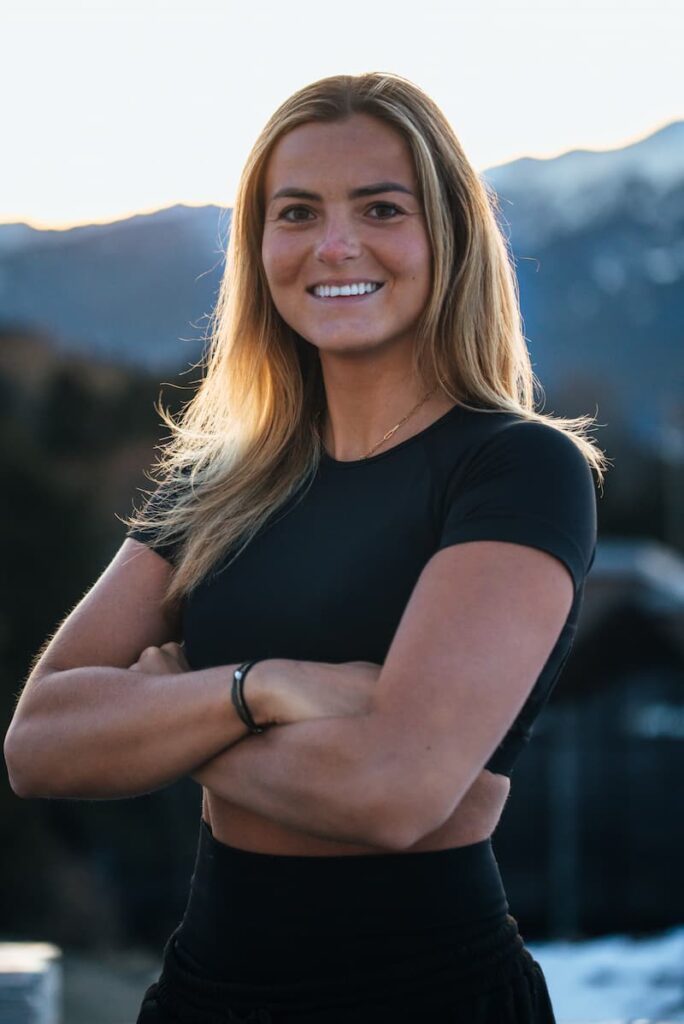
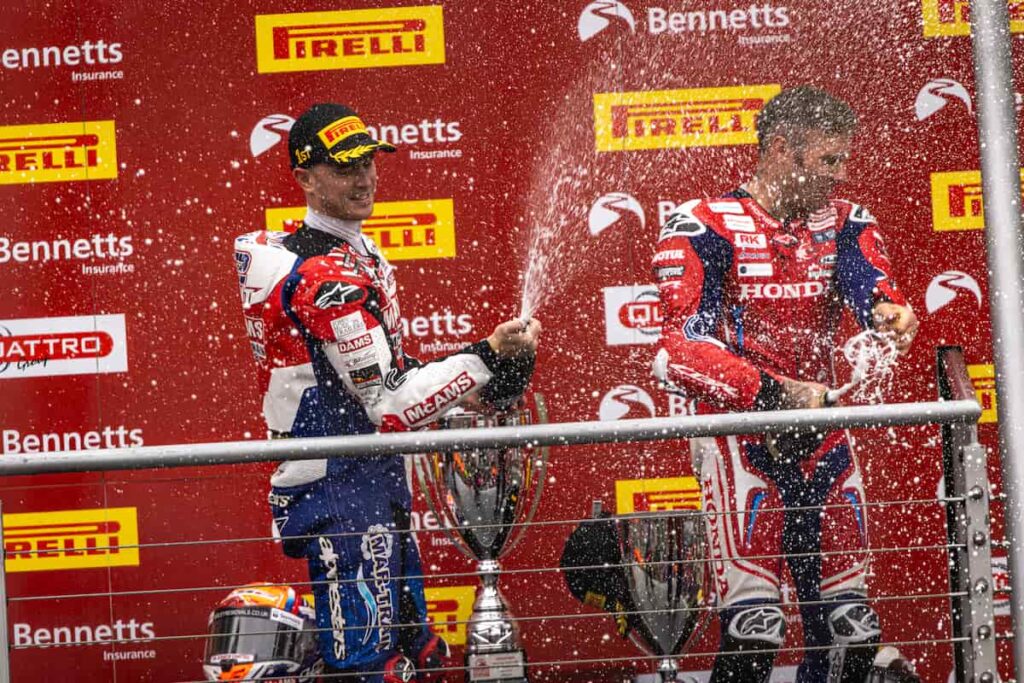
2025 – before Cremona’s first WorldWCR race, starting P11 on the grid | Photo by William Joly
Emily Bondi — Top 15 world rider, FIM Women’s Circuit Racing World Championship
There’s a version of Emily Bondi’s story that reads like a clean, easy climb: title in France, step up to a world championship, a polished presence on the grid.
But the version that actually matters — the one that lasts past a single season — is more interesting.
Because when you talk to Emily, you don’t get a highlight reel. You get a rider who’s learning how to build something sustainable: a process that holds up when confidence wobbles, when results don’t match effort, when the paddock gets loud, when your body says “stress” before your brain has time to translate it.
She’s not trying to become someone else to fit the space. She’s learning how to make space — for her riding, her values, and the creative side of the sport she genuinely loves.
Starting Late, Rising Fast
Emily’s whole journey as a rider isn’t actually that long.
“I started three years ago,” she says. “My first year of racing was 2023, in France, in the national Women’s Cup. I finished the season as French champion in the 600cc category and overall, in the scratch classification.”
That first title changed the meaning of everything.
Until then, riding was still “just a hobby.” Then the results arrived, and with them came doors — and expectations.
She was already working with Zelos and Xavier Siméon at the time. They’d been clear from the beginning: win in France, and bigger opportunities appear. The FIM Women’s Circuit Racing World Championship becomes real.
“I didn’t really know where I wanted to go,” she admits. “I just knew I loved riding. But when I signed with my first partner, everything changed. Before I signed, it was my hobby. When I signed, it became my job.”
The contract wasn’t just paperwork. It was an agreement with the next level: more pressure, more eyes, more responsibility — and a new kind of loneliness that people don’t always see from the outside.
“When you put your signature, you’re engaged,” she says. “You’re not just playing anymore.”
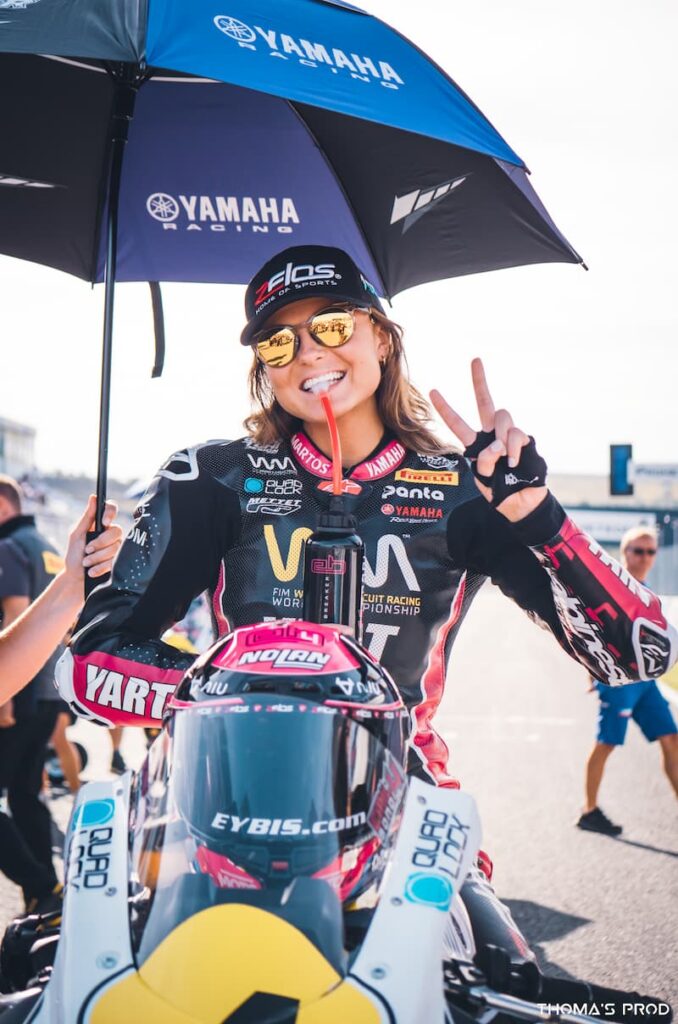
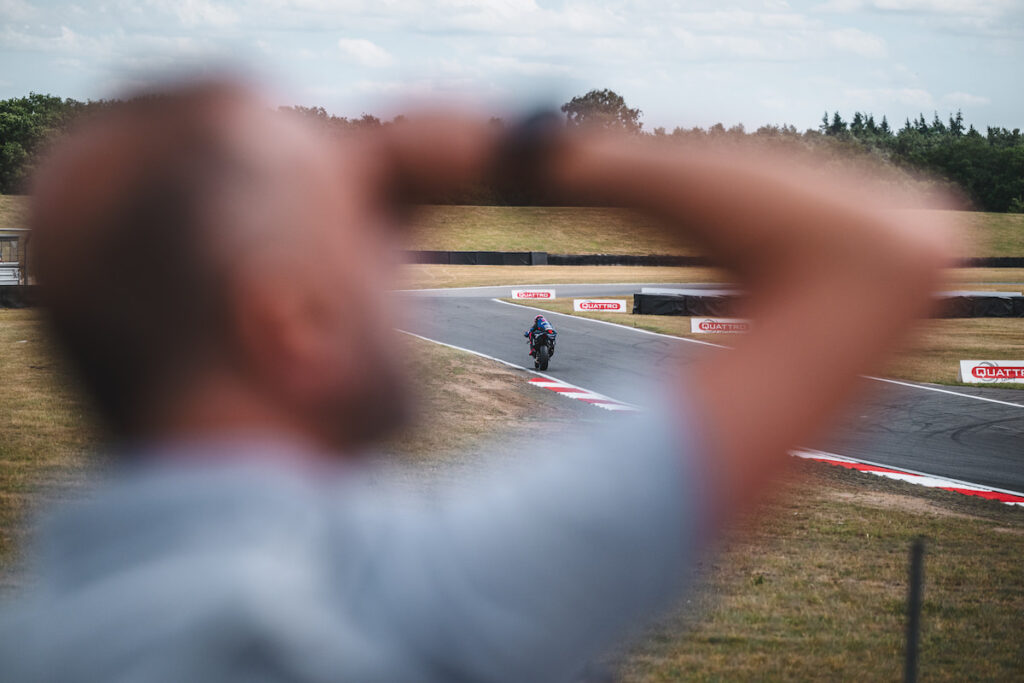
Jerez 2024 – before Race 2, surrounded by her family and a friend who is holding the umbrella | Photo by Thoma’s Prod
The Hardest Hour
If you want the most honest entry point into Emily’s mind, it’s not the podium. It’s the hour before a race.
“The hardest moment for me is from one hour before the race until the lights go out,” she says. “Every time I try to work mentally to skip this part, but it’s hard.”
Her body reacts before the story catches up.
“My body reacts before my brain catches up,” she says. “I feel it in my stomach, in my breathing — the whole system goes loud.”
This is one of the most useful truths she offers other riders: confidence isn’t always a feeling you get before you ride. Sometimes it’s something you build through a repeatable routine — by treating nerves like information, not a verdict.
And once the lights go out?
Everything changes.
“I feel most myself when I’m at the pace I’m supposed to be,” she says. “For example, if I talk with my mechanics and we say, ‘Okay, it would be good to finish between P8 and P10,’ and during the race I am there, in that group, fighting for those places — that’s where I feel happy.”
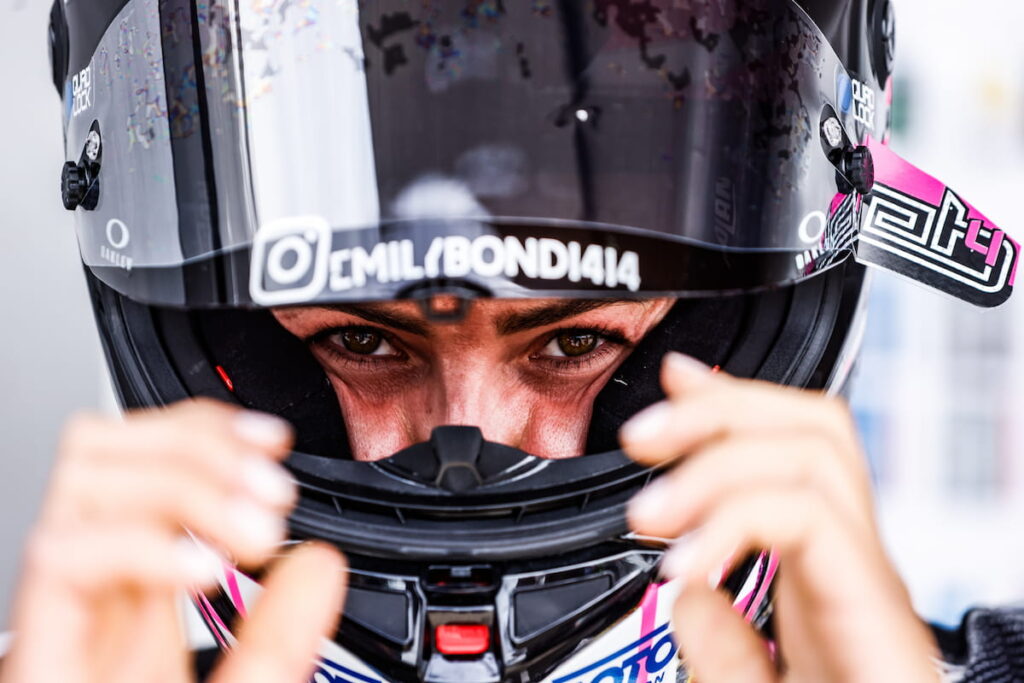
You can’t see it on TV, but under the helmet there’s a smile.
“I love the game of being passed, passing back, fighting. That’s where I feel like Emily.”
Rituals: Headphones On, World Off
Emily doesn’t romanticize mindset. She operationalizes it.
“I have a playlist called ‘Warm-Up Races,’” she says. “One of the tracks is ‘Transition’ by TRYM. It has a really high BPM. It puts me in the right condition.”
Her process is simple but intentional: back to the tent, leathers on, the same white headphones — stained from long days at the track — then glasses on. A signal to the world, but mostly to herself.
“When I put my glasses and headphones on, it means, ‘Don’t talk to me. I’m in race mode now.’”
She sits, drinks her sports drink, and rides the track in her head: picturing overtakes, imagining herself imagining the right decisions in the right corners.
On the grid, after the warm-up lap, there’s one more moment.
“I shout inside my helmet,” she says. “Like I’m turning a light on. Then the start lights go on, then off, and that’s it — time to work.”
It’s not mystical. It’s a switch.
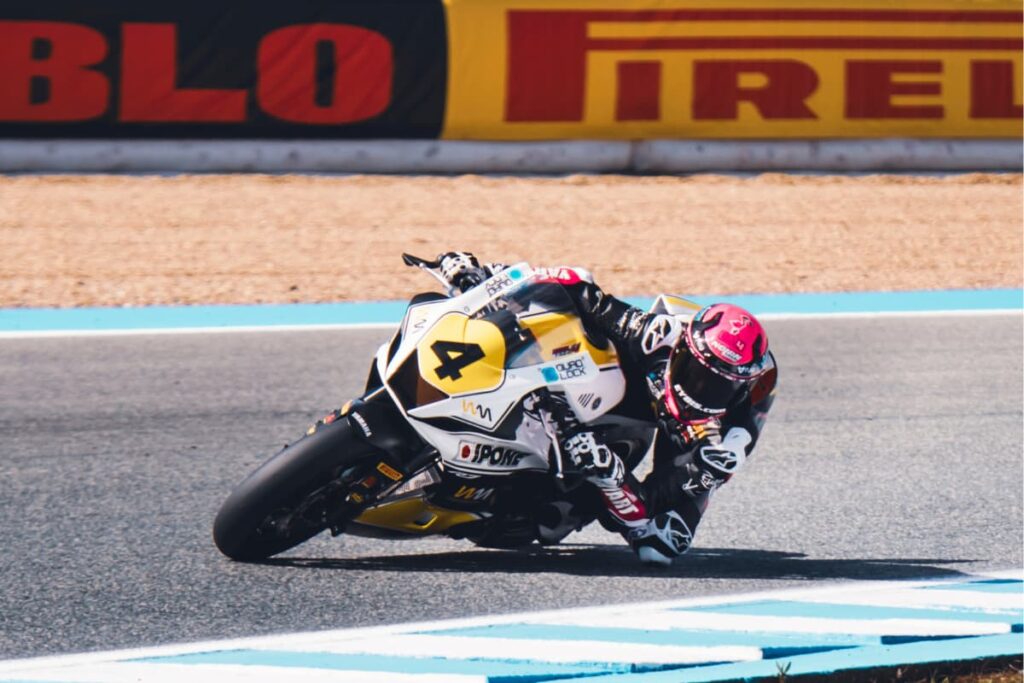
Jerez – final round, October 2024, during WorldWCR qualifying | Photo by Thoma’s Prod
Building the Craft Backwards
One of the strangest parts of Emily’s story is the order of it all.
She didn’t get the slow build most racers get — years of fundamentals before the pressure of “results.” She won early, then had to learn the foundations under a spotlight.
“I never had the beginning stages that many riders have,” she says. “I didn’t start at five years old. I started and almost immediately became French champion. So I missed all the small steps — why the bike turns, how braking really works at speed, the fundamentals most riders learn over years. I’m only learning those now.”
After last season, she made a decision that reads very “pro” when you zoom out: don’t push harder on a shaky foundation. Change the environment. Change the structure. Learn from zero where you need to — even if your résumé says you shouldn’t have to.
“So I changed my environment,” she says. “I joined FT Racing Académie. I have a French teammate I like and respect — Line Vieillard. I hope we can grow up together and help each other.”
She’s also working closely with a coach who has raced at a high level and is now integrated into her daily training.
“He told me, ‘With this training program, it’s impossible you don’t grow as a rider,’” she says. “So my priority now is to trust him, to follow the plan, and to let myself learn from zero in some areas.”
One of those areas is braking and body position.
“Braking was one of my strengths before,” she says, “but my position on the bike changed and started to work against me. It stopped helping me turn and carry speed into the corners. So now we’re rebuilding those basics — almost like I finally get the ‘beginner’ years I never had, just compressed into a professional program.”
It’s a rare kind of confidence: the willingness to rebuild when it would be easier to protect the image.
Get the Inside Line
Real stories, track insights, and paddock moments — straight from riders who live it. No noise, no fluff, just the DNA of the track delivered to your inbox.
The Reset That Forced Clarity
There’s a section of Emily’s story that could easily become the headline — the hard season, the injury — but she doesn’t treat it like the whole identity. She treats it like a turning point.
Last year, she says, was difficult mentally. At one point, at Donington Park, she found herself further back than she expected — and couldn’t make sense of why.
“I found myself fighting further back than I expected,” she says. “And I couldn’t understand why.”
“You don’t show up to fight at the back,” she adds. “I couldn’t understand what had changed — the bike, the setup, my approach — or why I couldn’t access my pace.”
Later in the season, at Magny-Cours — her home race — there was contact and she got injured.
“I broke a lot of bones in my hand,” she says. “Even now this finger doesn’t bend like the other one. On the bike it’s okay, I already tested that. But something in my head shifted.”
Then she says something that’s uncomfortable — and useful.
“When I crashed and realized I was injured, a part of me was… relieved,” she says quietly. “Relieved that the season could stop. That scared me — not because it was dramatic, but because it told me I was depleted. I took it as a signal to rebuild my process, not abandon the sport.”
That line is the difference between a bad year and a growth year: she didn’t frame it as failure. She framed it as information.
And then she acted on it.
“It was a hard year — and very instructive,” she says. “But it also showed me what needed to change.”

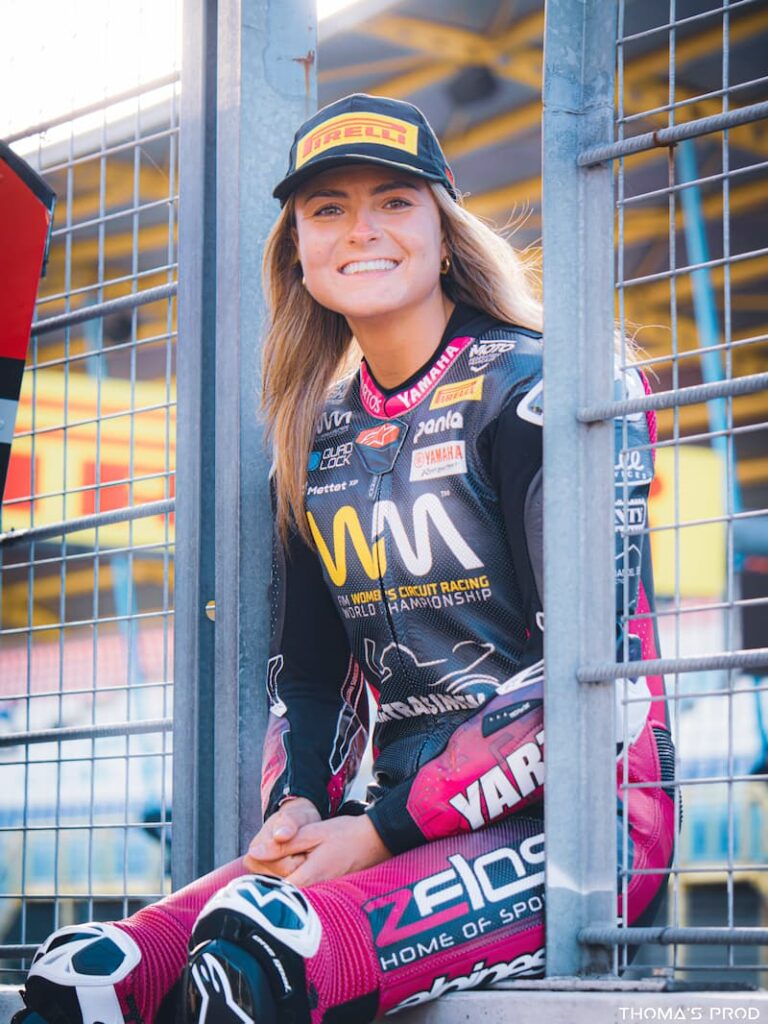
Assen 2025 – before the first race weekend of the year in WorldWCR | Photo by Thoma’s Prod
Choosing the Right Energy
Emily’s relationship with paddocks is honest — but it isn’t cynical. It’s selective.
She’s learned she performs better when she protects her energy. When she stays close to the people who are there to work. When she doesn’t feed the noise.
“I’ve learned how to protect my headspace,” she says. “To stay close to the people who keep it human.”
It’s also why she often leaves quickly once the job is done.
“When I finish a race, I often go straight back to my hotel,” she says. “It’s not me rejecting people — it’s recovery. It’s how I protect my energy so I can show up again tomorrow.”
She talks warmly about the people who do the unseen work — especially marshals.
“Without them, we don’t even ride,” she says. “They’re incredible.”
And she’s clear about what she wants her presence to feel like.
“I like things that feel more classic — a bit more classy, like Formula 1,” she says. “Moto can feel more blunt, more rough around the edges. So I bring my own style into it — classic, calm, intentional — because that’s who I am. I’m not trying to become louder. I’m trying to make space that feels like me.”
If a young rider came to her and said, “I don’t think I belong here,” Emily wouldn’t sell them a fantasy.
“I would say, ‘Me too. I also don’t always feel like I belong here. But I like it. And I’m trying to change my small part of it.’ If you don’t feel like you fit, you can still make your own place. You don’t have to become like everyone else.”
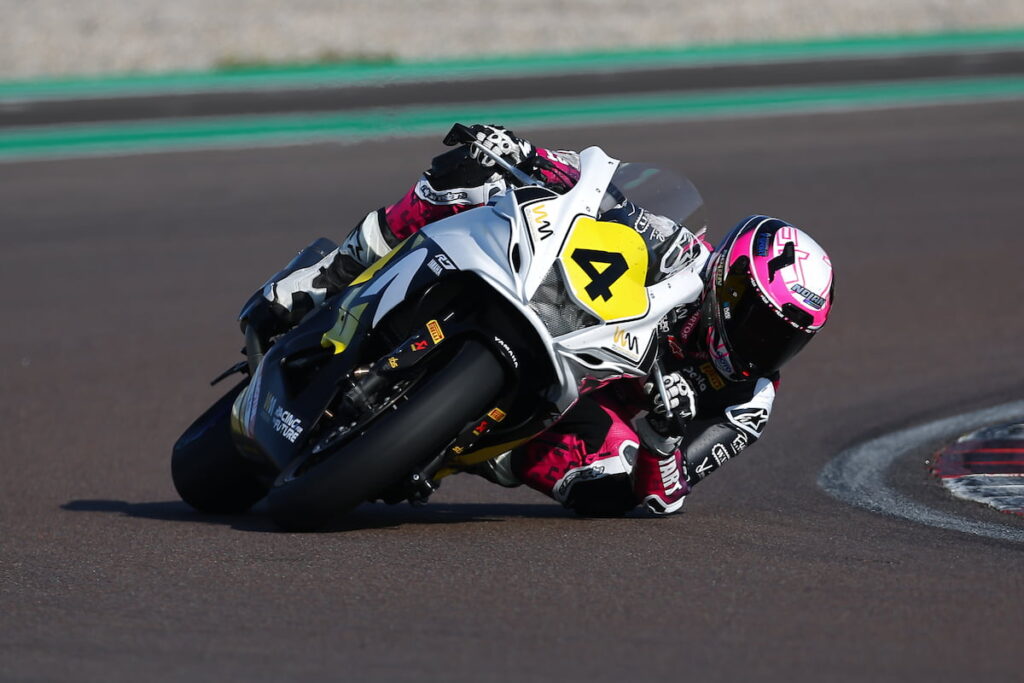
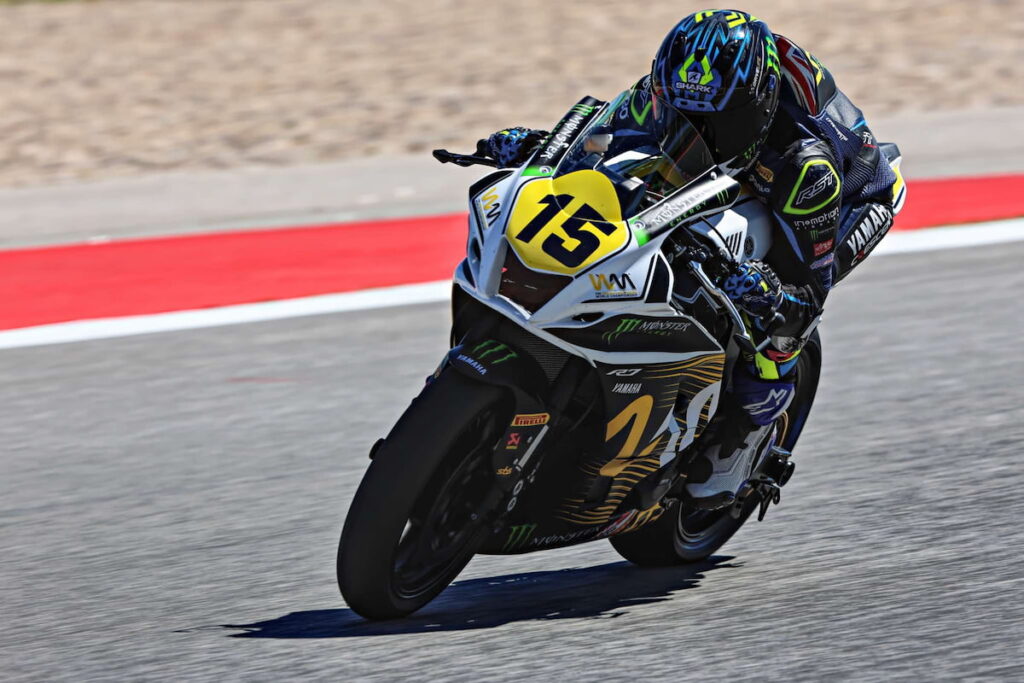
Testing at Cremona for WorldWCR 2025 – no sponsors on the bike yet, back to the fundamentals | Photo by Guillaume Cardiet
The Creator-Athlete Future
Emily doesn’t hide the part a lot of racers keep quiet: she genuinely enjoys the professional side.
“I love the professional side,” she says. “The brands, the marketing, the social media, the creation. I love making content.”
But the way she frames it matters: it’s not “posting.” It’s building.
She can see a future where her racing and her creativity live side by side — campaigns, storytelling, travel, production — work that’s intentional and stylish, not forced.
“Even if my time on that grid ends one day, I’ll still ride,” she says. “And I’ll still create — for brands, for the sport, for the parts of this life I genuinely love.”
In a world where riders are expected to be athletes and media teams at the same time, Emily’s honesty reads less like a distraction and more like a skill set she’s actively sharpening.
Redefining What a “Good Day” Means
At the end of a long day — helmet off, suit half unzipped, bike cooling next to her — how does Emily decide if it was a good day?
“At the moment, the only thing that tells me if it was a good day is the lap time,” she says. “And I know that’s not good. I know I need to change this.”
So she’s doing what she does best: building structure.
“I want someone outside me who can say, ‘Yes, this was good work today,’ even if the lap time is not perfect yet,” she says. “If my coach is happy with the work, I want to learn to be happy too — based on the effort, not just the number on the dash.”
It’s not a soft goal. It’s a performance goal. Because riders who can only measure themselves by the dash are easy to break.
Next Season: What She’s Building
Emily isn’t chasing a perfect image. She’s chasing a better process.
This season, her priorities are clear:
Rebuild fundamentals with structure (braking and body position)
Turn pre-race nerves into a repeatable routine she can trust
Keep her circle strong and her energy protected — so the work stays clean
Create with partners in a way that feels intentional, classic, and high-effort
It’s the kind of plan that makes sponsors exhale. Not because it’s flashy — because it’s sustainable.
Making Space
Emily isn’t trying to be a perfect hero in her own story. She’s trying to be honest, to grow, and to make space in the paddock for a different kind of presence — one that’s classic, thoughtful, and built on real work.
And that, more than any single result, might be the most important thing she brings to the grid.
Whatever the results sheet says next season, there will be one constant: a white-headphoned French rider on the grid, flipping the switch — and making just a little more space for anyone who’s ever loved this sport and wondered if they truly belong.
Emily Bondi in her element | Photo by Guillaume Cardiet
We’re genuinely inspired by the way Emily is rebuilding herself — not just as a rider, but as a whole one-woman company — and we’re excited to see where this next season takes her. If her story resonates with you, keep an eye on her racing and creative projects by following her on her social channels, and stay connected with TrackDNA for future features and updates as her journey unfolds.
Get the Inside Line
Real stories, track insights, and paddock moments — straight from riders who live it. No noise, no fluff, just the DNA of the track delivered to your inbox.
Author
-
Sean studied in Southeast Asia, did his stretch in corporate America as a Chief Revenue Officer, and then traded boardrooms for pit lanes. He’s a published author, and these days he’s on the grid with CMRA - on his way to MotoAmerica - and behind the scenes as the slightly obsessed human building TrackDNA, a magazine for riders who care as much about the culture and craft as they do about lap times.
Recent Posts