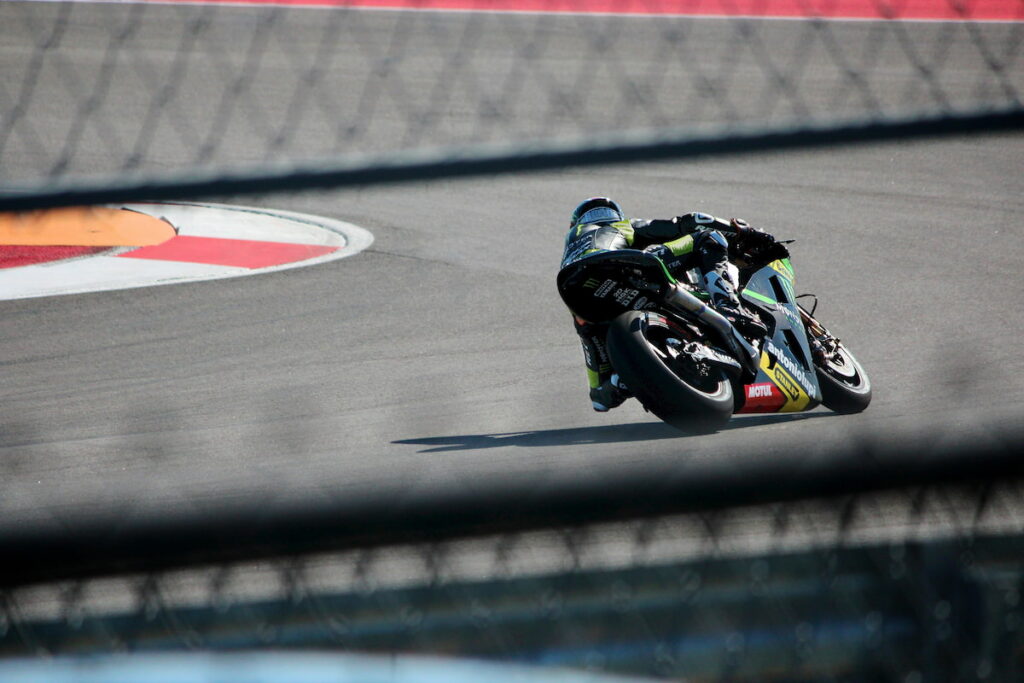
Photo by Harlie Raethel
Author’s note:
Huge thanks to Jason Litton — not just for stepping in and coaching me through that COTA weekend, but also for taking the time to walk back through it with me for this story. The lessons in here are from the saddle and from his eye as a coach.
Most people rolled into COTA the night before, already tucked into their pit spots, sipping coffee and swapping stories under the glow of trailer lights. I wasn’t one of them. I had loaded the bike the night before, went to bed early, woke up at 3AM, and by 5AM I was rolling into the tunnel at Circuit of the Americas.
If you’ve ever been to COTA, you know this isn’t just a racetrack. It’s a place where MotoGP legends have carved history into the asphalt — where Marc Márquez became the youngest MotoGP winner during the first Grand Prix of the Americas in 2013, where Maverick Viñales stunned the world in 2024 with a blistering 2:00.864 pole lap, and where even a stray dog once sprinted across the circuit during practice in 2015, earning the nickname “Moto” before being adopted into a new life. COTA is full of stories written by speed, chaos, and the riders who chase both.
As coach Jason Litton puts it, the first shock for new riders is simple: the scale. The track is bigger, wider, and longer than smaller club circuits, with more line and passing options — and more speed, which also means more braking force into corners. For a first visit, those early laps should be about learning the track, not chasing lap times.
Walking from the paddock to pit lane felt like stepping through a portal into a different dimension. The electricity in the air was real. You could almost feel the ghosts of race lines and late-brake heroics drifting between the garages.
This was my first time at COTA — not just riding, but being there at all. And I was about to learn that excitement and readiness are not the same thing.
TrackDNA Safety Note
Riding motorcycles on track is inherently risky and can result in serious injury or death. The ideas in this article are shared for general information only — they’re not formal coaching, professional instruction, or a guarantee of safety or performance.
Always ride within your limits, use proper safety gear, and practice only in a controlled, closed-course environment that follows all rules and regulations. Before trying any new technique, talk with a qualified coach or instructor and use your own judgment about what’s right for your skill level, your bike, and your body.
The best place to explore and apply these ideas is with a qualified coach or at a dedicated motorcycle or racing school. Treat what you read here as background context and conversation fuel for your own training — not as a step-by-step guide or a substitute for in-person instruction.
By choosing to ride, you accept the risks that come with it.
When the First Session Hits Hard
I’d only ridden my R6 a few times on track before this. I had slicks I trusted, great Brembo brakes, suspension tuned just right, and I was finally getting comfortable with GP shift.
At my home track, Harris Hill Raceway, I was already in intermediate and felt fine. So I signed up for intermediate at COTA too.
But COTA isn’t Harris Hill.
Before the first session even began, my coach realized I was the only one in our 4:1 group who hadn’t been there before. The other three riders already knew the lines, the flow, the rhythm. And COTA has rhythm — long blind corners, tightening radiuses, fast switchbacks, reference points that only make sense after a few laps of humility.
Session one was humbling. On lap one, I went wide in two different corners — not by a hair, but wide enough that whatever confidence I had evaporated instantly. I didn’t know the reference points. I didn’t know where the real apexes lived. I didn’t know how many lefts or rights were coming next.
It felt like being a beginner again.
From the Paddock to Your Inbox
Subscribe to our newsletter for new stories, issue updates, and paddock news.
The Conversation No Rider Wants to Have
After the session, my coach pulled me aside. Not angry — just concerned.
He explained that I was a safety risk, both to myself and others. And he wasn’t wrong.
He turned to the other riders and said:
“Next session, you guys go ahead. I’m going to stick with him and show him the lines.”
I was frustrated and embarrassed, but also grateful. In the second session, he showed me lines and watched me attempt them. But it wasn’t just about the lines — I had no landmarks, no corner memory, no rhythm. Every lap felt like starting from scratch.
By the third session, he told me plainly:
“You might benefit from moving to the beginner group.”
Painful, but correct.
The problem?
316 Superbike Camp runs a strict 4:1 student to coach ratio — which is part of what makes 316 quite unique compared to other track-day organizers — and the beginner group was full.
I was stuck between groups with nowhere to go. I’d come all the way to COTA only to feel like I’d already failed the track.
I wasn’t ready to be sidelined. But deep down, I was already thinking this might be the end of my COTA adventure.
The Turn That Led to a Better Line
That’s when Jason Litton stepped in — retired CMRA racer, one of the partners at 316, and a coach with the kind of calm presence that instantly earns trust.
He approached casually and said he’d take me on for the rest of the weekend.
One-on-one.
I didn’t yet understand the value of that.
A Necessary Reminder on Track-Day Group Selection
Before going deeper, there’s something important worth mentioning.
Track-day organizers — including 316 — consistently remind riders to choose their groups honestly, especially when registering for a new or unfamiliar circuit. Group placement isn’t about ego; it’s a safety tool, and it works best when riders are mindful about where they truly belong.
Looking back, signing up for intermediate at a track I had never ridden was my call. Like many riders, I wanted to push myself — but COTA isn’t the kind of place where you take guesses. It rewards self-awareness and preparation.
Jason sees the impact of mismatched groups all the time at COTA: a wide track with lots of passing options that can still get bound up when speeds and skill levels don’t match. A newer rider might be able to turn the throttle on the straights, but if their lines, braking points, and passes aren’t clean and predictable, it’s not safe or enjoyable for anyone.
For him, being fast isn’t the main objective — being smooth and predictable is. Mentors will move you up if you’re riding clean and safe. A rider might be “fast enough” for a higher group and still get moved down if their riding is erratic. In those cases, Jason would rather slow things down, help the rider relax, and build on smoothing and perfecting skills instead of letting them rush their way into trouble.
And the one-on-one coaching I received that weekend?
That was a generous exception — a moment of perfect timing and a coach willing to step in. It’s not something riders should expect from any organizer. It was simply a gift, and I was fortunate to be on the receiving end of it.
The First Fix — Gear Selection and Bad Habits
The first thing Jason picked up on was something I didn’t even realize I was doing:
At Turns 11 and 12, every time I downshifted, I glanced down at my gear indicator.
That told him everything.
I wasn’t confident in my gear selection. I was letting the bike make decisions for me. And worst of all, I was taking my eyes off the only place they needed to be.
He didn’t sugarcoat it:
“You should never be looking down at your dash.”
That alone cleared half the chaos.
Later, when I asked Jason what he looks for first when someone is clearly overwhelmed on a new track, he described almost exactly what I’d been doing: stiff on the bike, eyes dropping instead of looking where they want to go, fidgeting with controls. When he sees those signs, the conversation off-track becomes simple: breathe, relax, and slow the next session down if needed. Sometimes that means riding whole laps in just a couple of gears — second and third, maybe fourth on the long straights — to let the rider settle in and build confidence without juggling the entire gearbox.
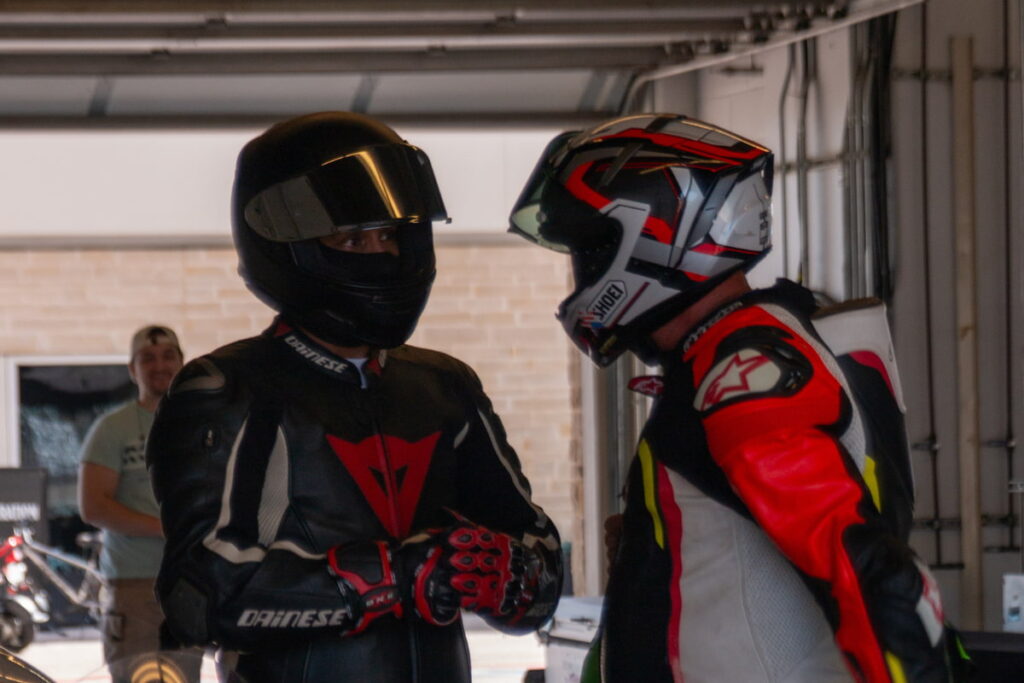
Photo by David Schwartz – COTA 2025 | Jason Litton on the right
Seeing, Not Staring — Learning Proper Track Vision
The next correction was bigger.
I wasn’t looking far enough ahead. I stared at apexes instead of looking through them.
Jason led for a lap, then had me lead. He watched my body position, vision, throttle roll, and entry timing. Slowly, I began collecting reference points, building a mental map, and letting my lines settle into something resembling intention.
He always brings it back to a simple foundation: look where you want to go. Everything else — braking markers, turn-in points, exit references — gets built on top of that.
“Reference points are a tool, not an absolute rule,” he told me. He’s seen riders get so nervous and focused on a tower, pole, or sign that they drift toward it, or run off track, instead of following the line they actually want to ride. If you’re too locked onto an off-track object, you’re not truly looking ahead at the line you want.
I felt smoother. More controlled. Less chaotic.
But the real breakthrough came the next morning.
The Breakthrough Moment at Turn 12
The first session of day two felt strangely familiar — calmer, almost like revisiting a place I had slept on.
Coming into Turn 12, with Jason shadowing me from behind, I hit my braking marker… and suddenly realized my brakes were giving me only half the force. Later, at the shop, I found out a piston in the right caliper had seized — a quiet reminder that COTA exposes every weak link on your bike.
In that split second of panic, Jason’s voice echoed in my head:
“Look where you want to go.”
Even wide — maybe 2 or 3 feet from running off the track — I focused ahead. And the bike followed. Smooth. Predictable. Almost like it wanted me to succeed.
That was the moment everything clicked.
Repetition builds skill.
Vision unlocks speed.
Intention makes the bike obey.
Jason’s Coaching Style — Calm, Technical, and Precise
Session by session, Jason gave me simple, digestible lessons. Even complex corners became practical.
He explained how to thread the Esses, how to set up for the chicane, and how Turns 16 through 18 work if you treat them as a single flowing arc. After every session, he drew lines, pointed out my progress, and recalibrated my mental map of the track.
He was patient, analytical, and quietly relentless — the rare combination that turns chaos into craft.
Ask Jason what really changes when a rider has that “breakthrough moment,” and he doesn’t start with lap times or body position. “Calmness is the breakthrough moment,” he says. Breakthroughs happen when a rider is relaxed enough to notice what went right, understand why it worked, and repeat it. That’s when motions become smooth and balanced instead of mechanical, forced, or erratic.
His coaching goal reflects that. He doesn’t bark or hammer riders about what they did wrong. He’d rather give clear corrections in a positive way so they can roll out for the next session as relaxed as possible — because relaxed riders learn faster, ride smoother, and stay safer.
And every correction made me smoother.
That’s when trust locked in fully.
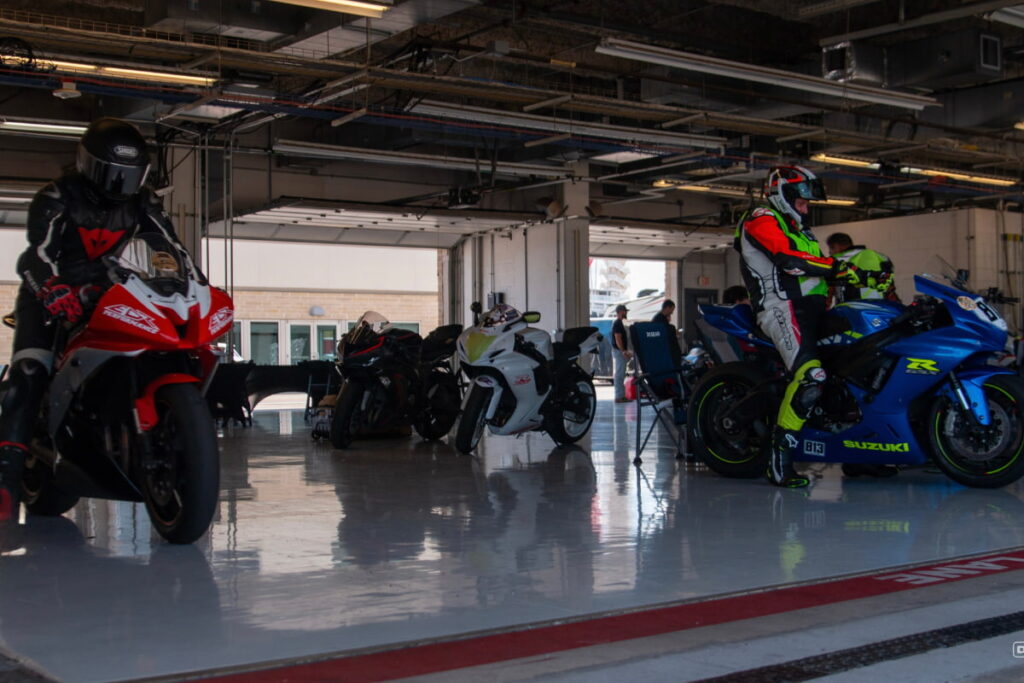
Photo by David Schwartz – COTA 2025 | Jason on the right
Catching Up to the Group — And Catching On
By the second afternoon, something surreal happened:
We started catching my former intermediate group.
I even passed a few riders — not dramatically faster, but noticeably smoother.
And smooth is always faster than chaotic.
What could’ve ended my track journey became the pivot point. Jason didn’t just coach me — he saved that weekend, and honestly, my trajectory in this sport.
It’s the reason I’m preparing for my CMRA journey today.
The Weekend That Shifted My Riding Journey
I’ve learned from every coach I’ve had — each shaping a part of me. But Jason stepped in when I was vulnerable, frustrated, and one bad session away from walking off the track for good.
If he hadn’t taken me under his wing that weekend, I’m not sure I would’ve come back. Instead, here I am — still riding, still learning, and now inspired to become a coach one day myself.
Jason has a way of zooming out that keeps COTA — and every big track — in perspective. To him, it doesn’t matter whether it’s a small club track or a world-stage circuit like COTA, whether you’re a MotoGP pro or it’s your very first track day. At the end of the day, we’re all doing the same thing: putting on our gear, heading out to have fun, and trying to finish the day safely so we can go to bed dreaming about the next time we get to do it again.
The best days, he reminds riders, are always fun and relaxed. The scale of COTA shouldn’t discourage you or make you nervous — it should just be another place where you learn, breathe, and keep showing up.
And if I ever see someone in the position I was in that afternoon at COTA, I’d tell them this:
Be open. Be patient. Be willing to be wrong.
And whatever you do — don’t give up yet.
TrackDNA Takeaways for Riders
- Vision beats bravery.
Looking where you want to go will save you more than courage ever will. - Don’t rely on your gear indicator.
Feel the bike — don’t look down for answers. - Smooth always beats fast.
Chaos feels quick. Smooth is quick. - One-on-one coaching can accelerate your progress tenfold.
- Mechanical discipline matters.
Clean and inspect your calipers — and everything else — especially before big tracks. - Being moved down isn’t failure.
It’s an investment in safety, technique, and your long game as a rider. - Relaxation isn’t optional — it’s the foundation.
The best days at COTA or any track are the ones where you’re calm, present, and having fun.
Editor’s note (December 2025):
At the time of writing, Circuit of The Americas has announced “THE CIRCUIT,” a private driving club opening in 2027. According to COTA, from 2027 the Grand Prix track will be limited primarily to members, races, and special events. For many riders, that means 2026 is being treated as the last realistic window for public track days at COTA.
Issue 01 is
Out Now
TrackDNA Issue 01 is a 124-page premium, community-driven magazine for motorcycle track riders & enthusiasts.
Author
-
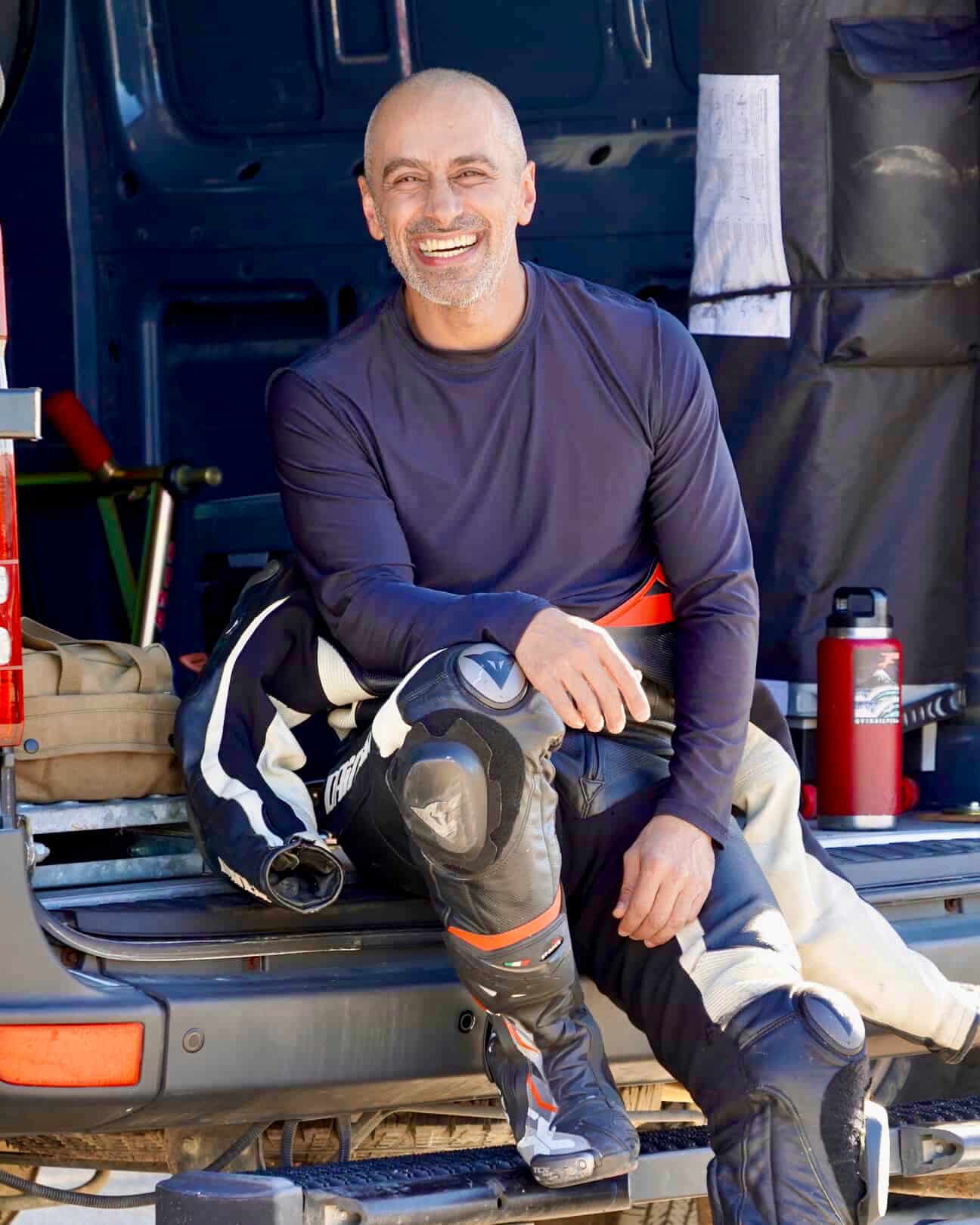
Sean is the founder and Editor-in-Chief of TrackDNA, an independent magazine for motorcycle track culture. A CMRA racer and former motorcycle mechanic, he built TrackDNA to preserve the parts of the paddock that usually disappear once the weekend is over - the work, pressure, craft, people, and small decisions behind the visible lap.
His writing is shaped by time on both sides of the bike: riding, wrenching, listening, and paying attention to what the sport asks from people before anyone sees the result.