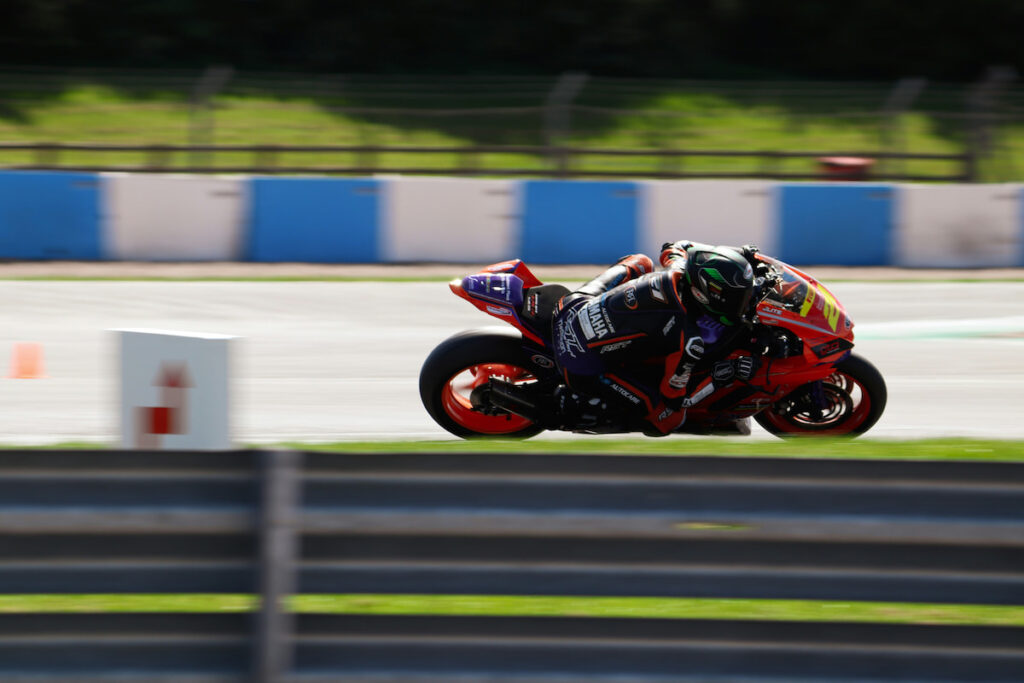
Photo by David Schwartz
Most riders expect their first track day to be loud, chaotic, and a little intimidating.
Mine wasn’t.
It was quiet, human, and surprisingly welcoming. It didn’t just change how I felt about that day – it changed what I thought track life actually was.
Your first track morning doesn’t hit all at once. It sneaks up on you in the cool air before sunrise and the quiet shuffle of riders setting up – that weird mix of nerves and calm that tells you you’re stepping into something new. That’s what my first morning at Harris Hill felt like.
TrackDNA Safety Note
Riding motorcycles on track is inherently risky and can result in serious injury or death. The ideas in this article are shared for general information only — they’re not formal coaching, professional instruction, or a guarantee of safety or performance.
Always ride within your limits, use proper safety gear, and practice only in a controlled, closed-course environment that follows all rules and regulations. Before trying any new technique, talk with a qualified coach or instructor and use your own judgment about what’s right for your skill level, your bike, and your body.
The best place to explore and apply these ideas is with a qualified coach or at a dedicated motorcycle or racing school. Treat what you read here as background context and conversation fuel for your own training — not as a step-by-step guide or a substitute for in-person instruction.
By choosing to ride, you accept the risks that come with it.
Arriving at the Track: First Impressions That Stay With You
We rolled through the gate around 6:00 a.m. I showed up with a friend – a retired club racer and mentor – who’d helped me load the bike the night before. His fully prepped, race-ready R1 sat on the trailer next to my XR400, a bike that looked like it had escaped a ranch and taken a wrong turn into the paddock.
The contrast between beginner and veteran couldn’t have been clearer. That moment alone taught me more about track life than any YouTube tutorial ever could.
The sun hadn’t crested yet, just a faint blue over San Marcos. A few bikes idled in the lot. A handful of riders were already unloading, moving like they’d done this a hundred times. As I walked past a bike with a proper race setup, something else hit me: a smell I didn’t recognize at first – fuel, but sharper, cleaner, almost sweet.
Race fuel.
That smell alone told me I’d stepped into a different world.
The Smells, Sounds, and Vibe of the Paddock
I was nervous, but not in a panicked way. More like hyper-aware. Like most first-timers, I tried to blend in, stay quiet, and just watch how everyone else moved.
That lasted maybe five minutes.
Someone nearby struck up a conversation – simple stuff at first, where I came from, what I was riding, how I’d heard about the day. The moment we started talking, the edges softened. I could feel my shoulders drop a little.
I’d arrived with a stereotype in my head: a paddock full of A-type adrenaline junkies, intimidating alpha personalities, people too serious to bother with a new guy on an XR. Instead, I met riders who were grounded, funny, and genuinely helpful. That flipped my assumptions fast.
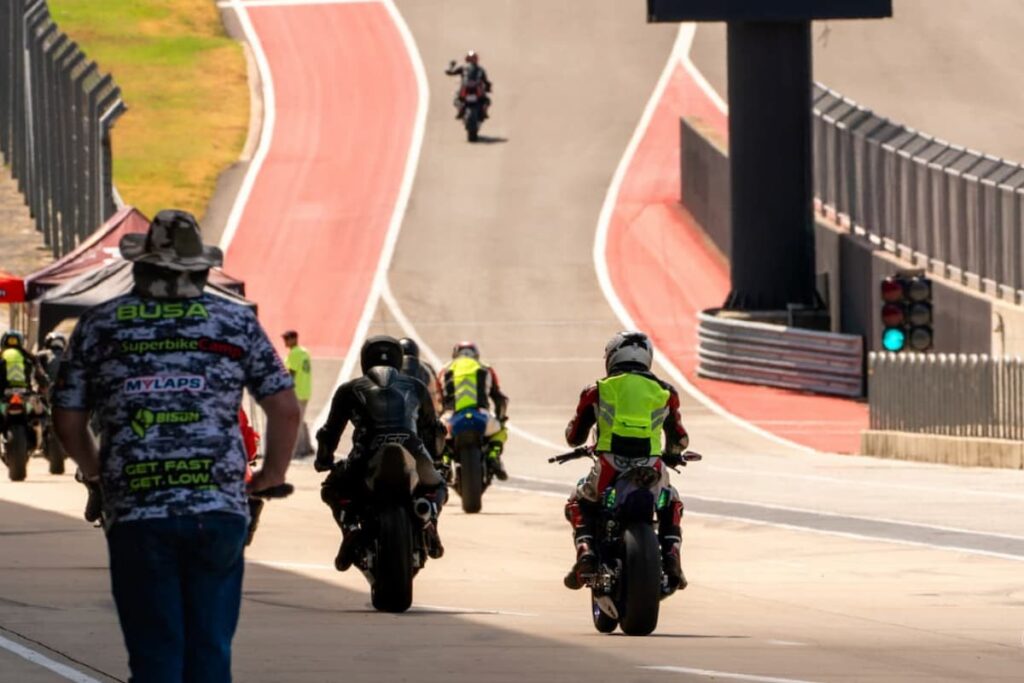
Even though I didn’t know the rhythm of a track day yet, the morning still made sense. People moved with quiet purpose. Canopies went up. Bikes went on stands. Tire warmers clicked on. It was like everyone understood the same unwritten code, and I was getting my first look at it.
Get the Inside Line
Real stories, track insights, and paddock moments — straight from riders who live it. No noise, no fluff, just the DNA of the track delivered to your inbox.
Showing Up Imperfect: Gear, Setups, and the Reality of Being New
Then there was my setup.
I rolled in with a 1999 XR400 I’d turned into a “supermoto” about two weeks earlier. Kickstart. Dirt DNA everywhere. The gear situation wasn’t much better: a leather suit one size too small, gloves that wouldn’t have done much in a slide, dirt-bike boots two sizes too big, and one excellent Shoei helmet trying to hold the whole thing together.
On the outside, I probably looked confident enough. On the inside, I knew I was not dressed for the occasion.
What stood out to me was simple: nobody cared. No side-eye, no jokes at my expense, no “come back when you’re ready” attitude. Just nods, a couple of small tips, and offers to help.
That’s one of the first things I learned about the paddock. People see effort, not perfection.
The Morning Meeting: Setting the Tone for the Day
The rider meeting kicked off at 8:00 a.m. on the dot.
It opened with a prayer – simple, sincere, and grounding:
“Dear God, we give thanks for this blessing, to be here on a Monday. We give thanks for our awesome bikes. Please keep everyone safe.”
Then the organizer laid out the tone for the day in plain language: be mindful, be respectful, pass clean, ride with a goal and intention. No drama, no ego speech, just clear expectations.
After that, the coaches called their students, pointed out where they were pitting, and walked through what to expect before the first session. It was structured without feeling stiff. If you were paying attention, it was easy to follow.
Around us, the paddock built itself up. Some riders had full race-program setups – canopies, stands, tire warmers, toolbox stations, even mats under the bikes. You could hear the steady hum of generators, smell the crisp hit of fuel in the air, and catch little pieces of conversation about tires, gearing, and past track days.
On paper, none of that sounds special. But in that moment, it felt like getting handed a backstage pass.

When the Nerves Finally Disappear
Somewhere between the meeting and the first session, the nerves stopped barking so loud. I couldn’t tell you the exact moment it happened.
I stopped worrying about whether my bike looked out of place. I stopped obsessing over how “new” I probably looked. I started paying attention to the important stuff instead: the line into pit-out, where my coach was set up, how people flowed on and off track.
I realized I didn’t have to prove anything to belong there. The paddock had already made space for me.
What I Wish I’d Known Before My First Session
Looking back, there’s plenty I wish I’d done better before rolling out for that first session. I could’ve packed smarter. I could’ve taken the time to really read the guide the organizer sent instead of skimming it. I could’ve dialed in my gear situation instead of making it work at the last minute.
All of that matters. What you eat, how much water you drink, how you reset between sessions, how you lay out your pit so you’re not scrambling – it all adds up.
But here’s what surprised me: even with holes in my preparation, I never felt alone out there. Any time I had a question, someone nearby was willing to answer it. Community filled in the gaps my planning left open.
The Part You Don’t Really Understand Until You Go
From the outside, it’s easy to think track mornings are about speed, lap times, or who has the most serious setup. Standing in that paddock for the first time, I realized the real story lives in smaller moments.
It’s in the way riders help each other load and unload.
It’s in the way a coach remembers your name and checks in after a session.
It’s in the way a simple prayer at 8:00 a.m. reframes the whole day around gratitude and safety.
That’s when it clicked for me: this world isn’t a stage where you show off. It’s a place you share.
It only feels intimidating if you decide to stay on the outside of it.
Why Your First Track Morning Matters More Than Your Lap Time
Your first track morning is not an audition. It’s an introduction.
It’s where you learn how a track day really works, how the paddock breathes, and how quickly strangers can turn into “Hey, how’d that last session go?” people. The lap times come later. The culture hits you first.
If you’ve already had that first-morning experience, you probably know exactly what I’m talking about. If you haven’t yet, it’s worth paying attention to the little things when you finally roll through the gate.
And if you’ve got your own first-morning story, TrackDNA wants to hear it. Track life grows when riders share the real stuff with each other – the nerves before first session, the sketchy first setups, the small kindnesses at sunrise.
That’s why this magazine exists in the first place: to catch those moments and pass them from rider to rider, so the paddock never loses its soul.
TrackDNA Note: This story is about the culture and feel of a first track morning, not coaching. Every track day and organization runs a little differently. Always follow your org’s rules, listen to your coaches and control riders, and ride within your own limits.
Get the Inside Line
Real stories, track insights, and paddock moments — straight from riders who live it. No noise, no fluff, just the DNA of the track delivered to your inbox.
Author
-
Sean studied in Southeast Asia, did his stretch in corporate America as a Chief Revenue Officer, and then traded boardrooms for pit lanes. He’s a published author, and these days he’s on the grid with CMRA - on his way to MotoAmerica - and behind the scenes as the slightly obsessed human building TrackDNA, a magazine for riders who care as much about the culture and craft as they do about lap times.
Recent Posts