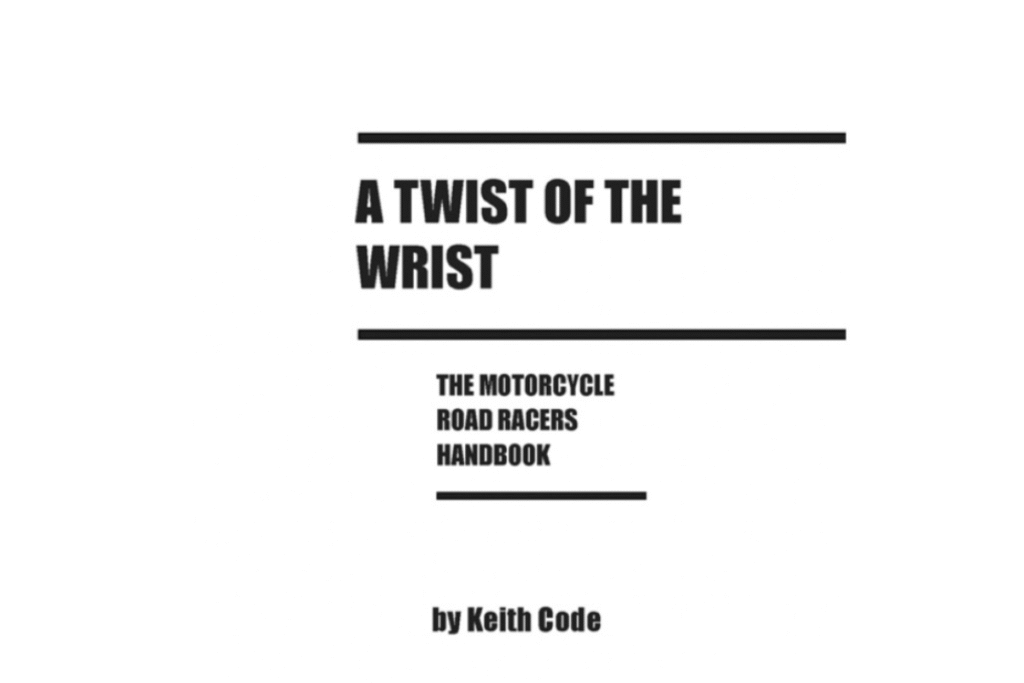
You don’t have to spend long in the paddock before someone mentions Keith Code.
Hang around a few track days and you’ll see it in real time: a dog-eared book coming out of a gear bag, somebody quoting “the wrist,” a California Superbike School logo on leathers that have clearly done a few seasons. He’s been breaking riding down into repeatable pieces for decades, and a ridiculous number of fast humans have come through that system.
I’m still early in my own track journey. I’m not a coach, I’m not a pro, and I’m not trying to play “mini Keith.” I’m just a rider who reads, rides, messes things up, then goes back to the pages and asks, “What was that?”
This piece is exactly that. What I’ve taken from Keith Code’s work so far – mainly A Twist of the Wrist II and the school philosophy around it – and how it started helping once I got past pure novice and into that awkward middle zone.
You know the one. You’re comfortable on track. You’re chasing seconds. And every now and then you still have a lap where you scare yourself a little.
TrackDNA Safety Note
Riding motorcycles on track is inherently risky and can result in serious injury or death. The ideas in this article are shared for general information only — they’re not formal coaching, professional instruction, or a guarantee of safety or performance.
Always ride within your limits, use proper safety gear, and practice only in a controlled, closed-course environment that follows all rules and regulations. Before trying any new technique, talk with a qualified coach or instructor and use your own judgment about what’s right for your skill level, your bike, and your body.
The best place to explore and apply these ideas is with a qualified coach or at a dedicated motorcycle or racing school. Treat what you read here as background context and conversation fuel for your own training — not as a step-by-step guide or a substitute for in-person instruction.
By choosing to ride, you accept the risks that come with it.
Survival reactions: the hidden handbrake
One of the biggest ideas Keith hammers on is what he calls survival reactions (SRs) – the instinctive, panic-driven stuff that shows up when your brain decides, “Nope, this is bad,” and tries to take the controls back.
At novice pace, SRs are loud and obvious. Sitting bolt upright mid-corner. Grabbing brake while leaned over. Staring at the thing you’re afraid of hitting.
What surprised me, though, is how SRs don’t disappear as you get better. They just get smaller and harder to spot.
At a quicker pace, my SRs aren’t dramatic. They’re subtle. They look like a tiny mid-corner roll-off when I feel a little wide. Turning in a beat early because I’m worried about “missing” an apex. Adding a little extra bar pressure when the bike twitches instead of letting it settle. Holding my breath and tightening my upper body when the lap starts to “matter.”
None of those sends me straight to the gravel by itself. But at speed, they stack up. And they quietly cap confidence and lap time.
The practical shift for me has been this: I stopped telling myself I’m “past” survival reactions. I assume they’re always in the room, and I try to catch them like a coach would.
A few checks that have helped me notice the small ones:
- Did I change my mind mid-corner? If yes, it usually means I rolled off, added steering, or tightened up when the bike was already doing what I asked.
- Did I breathe? On my sketchiest laps, the GoPro audio is basically inhale… inhale… inhale. If I deliberately exhale at turn-in and again as I start roll-on, my shoulders drop and the bike feels less tense.
- Am I creating the problem I’m afraid of? That little roll-off when I felt wide has often made the line worse, not better. The survival reaction becomes the cause, not the cure.
Once you can spot the micro-SRs, you finally have something real to work on. Not “I need more courage.” More like “I need to stop adding noise when the bike is already doing the job.”
The ten dollars of attention: where my focus leaks now
Keith’s “ten dollars of attention” concept hits hard because it’s so true on a track day. You only get so much mental bandwidth. Every fear, every half-understood idea, every comparison to the rider in front of you – it all costs something.
At novice pace, my attention got spent on the obvious stuff: where the line goes, which gear I should be in, whether that bump was going to ruin my day.
Now the leaks look different.
I’ve watched my ten dollars drain into lap timer fixation (“I’m up two tenths, don’t blow it”), comparing myself to faster riders, or trying to run three coaching concepts in the same lap. None of those thoughts are illegal. But if I’m carrying all of them at once, I’m broke before the session gets good.
The fix hasn’t been “think harder.” It’s been narrowing the job.
Lately I’ll give each session one focus that I can actually feel and repeat. A session where I care about brake markers. A session where I care about exit drive. A session where I care about corner entry calm. Everything else runs in the background on purpose.
It’s not glamorous, but it’s measurable. And it changes the vibe. Instead of riding like three different people in one day, I ride like one person doing one thing well.
Throttle Control: The Lap Is in Your Right Hand
If there’s one drum Keith has been beating for decades, it’s throttle control – especially what happens after you start adding throttle in a turn. How you roll on affects grip, geometry, line, and stability.
Modern coaching talks a lot about trail braking and carrying brake pressure deeper. At first, that can sound like it clashes with Code’s emphasis on getting back to a smooth, progressive roll-on. In practice, the overlap is bigger than the arguments make it seem. The common ground is simple:
Abrupt changes are the problem. Sudden roll-offs, chops, or spikes are what tend to light the bike up and light your brain up right after.
What I’m trying to clean up is the messy middle. The part where I’m “done braking,” but not committed to driving yet. That hesitation zone is where my SRs like to sneak in.
A few personal cues I’ve been leaning on, pulled from Keith’s language but filtered through my own mistakes:
I try not to coast by accident. If I’m off the brake, I want to know why. If I’m starting roll-on, I want it to be deliberate, light, and progressive.
I also aim for earlier, gentler, longer – not earlier as in reckless, and not longer as in forcing drive. More like: introduce throttle sooner at a smaller amount to stabilize the chassis, then keep feeding it in as the bike finishes the corner.
And when I do run wide, I’m trying to stop “escaping” with the throttle or “saving it” with a panic roll-off. If I truly messed up corner entry, I’d rather note it and fix it next lap than thrash my way through the current one.
Electronics are amazing, but they don’t replace clean habits. They just give you a little more room while you’re building them.

Vision: making the corner a plan
Keith’s visual drills get summarized as “look where you want to go,” and that’s true. It’s also not enough once the pace comes up.
What’s mattered more for me is treating vision like sequencing. My eyes shouldn’t be chasing what the bike is doing. They should be ahead of it, setting the plan.
On the straight, I try to find my braking marker early. As I’m coming off the brakes, my eyes go to turn-in. At turn-in, I want to “tag” the apex visually, then widen out to the exit and beyond.
If I catch myself staring at the patch of pavement right in front of the front tire, it’s a tell. I’m behind. That’s when my riding turns reactive and everything feels like a surprise again.
When I get this right, the lap feels calmer. Not slower – calmer. The bike feels more “on rails” because my inputs stop being last-second corrections.
Rider Input: Letting the Bike Do Its Job
A big takeaway from A Twist of the Wrist II – and the broader CSS approach – is how much trouble riders create with their own bodies. The motorcycle is usually capable. The question is whether I’m letting it do its job.
For me, the problem shows up in a few repeatable places: a death grip at corner entry or over bumps, hanging on with my arms instead of my legs under braking, and adding extra steering mid-corner because I don’t trust the first input.
So I’ve started checking for tension like it’s a system warning light.
On the warm-up lap, I ask myself if I can wiggle my fingers on the straight. If I can’t, I’m already too tight. Under braking, I try to feel my knees doing most of the work. If my arms are loaded, my steering is about to get messy.
And once I commit to a steering input, I’m working on giving the bike a moment to respond before I add more. Modern bikes are incredibly capable if we stop trying to micromanage them with extra inputs.
A Keith-inspired track day plan
If you want to apply these ideas without turning your next track day into a science project, here’s a simple structure that’s worked for me. Adjust for your pace, your coaching, and your track org’s flow. The point is having a plan instead of riding five sessions and hoping something changes.
Session 1: Warm up and hunt SRs
Keep the pace honest and comfortable. Your job is not speed. Your job is noticing: where do you flinch, roll off, tighten up, or change your mind mid-corner? After the session, write down two things you caught. Not ten. Two.
Session 2: Spend your ten dollars on one corner
Pick one corner that tends to drain you. Give most of your attention to that single section: brake marker, turn-in, and where you start roll-on. If your mind tries to jump to five other things, bring it back.
Session 3: Throttle discipline
Focus on making throttle changes smooth and deliberate. Look for the hesitation zone and see if you can shrink it. The homework isn’t lap time – it’s whether the bike felt calmer as you fed in throttle.
Session 4: Vision sequencing
Run the corner with a visual plan: find the reference, tag the apex, widen to the exit. If other riders keep surprising you, that’s data. It usually means your eyes are late.
Session 5: Let it settle
This is where you stop forcing progress. Put the pieces together and aim for clean, repeatable laps that feel stable. If it’s not your day to push, it’s not your day to push. There’s no shame in that.
That’s a Keith-influenced day without pretending you’re literally in his curriculum.
Why this still works on modern bikes
If this resonates, the best move is still the same: go to the source.
Start with A Twist of the Wrist II. Then, when the timing makes sense, look at a day with California Superbike School. These ideas come alive when somebody qualified is watching you ride and giving you real feedback.
If you’re in that awkward middle zone like me, that’s the whole point. Less guessing. More understanding. More clean laps you can repeat.
Author
-
Sean studied in Southeast Asia, did his stretch in corporate America as a Chief Revenue Officer, and then traded boardrooms for pit lanes. He’s a published author, and these days he’s on the grid with CMRA - on his way to MotoAmerica - and behind the scenes as the slightly obsessed human building TrackDNA, a magazine for riders who care as much about the culture and craft as they do about lap times.
Recent Posts