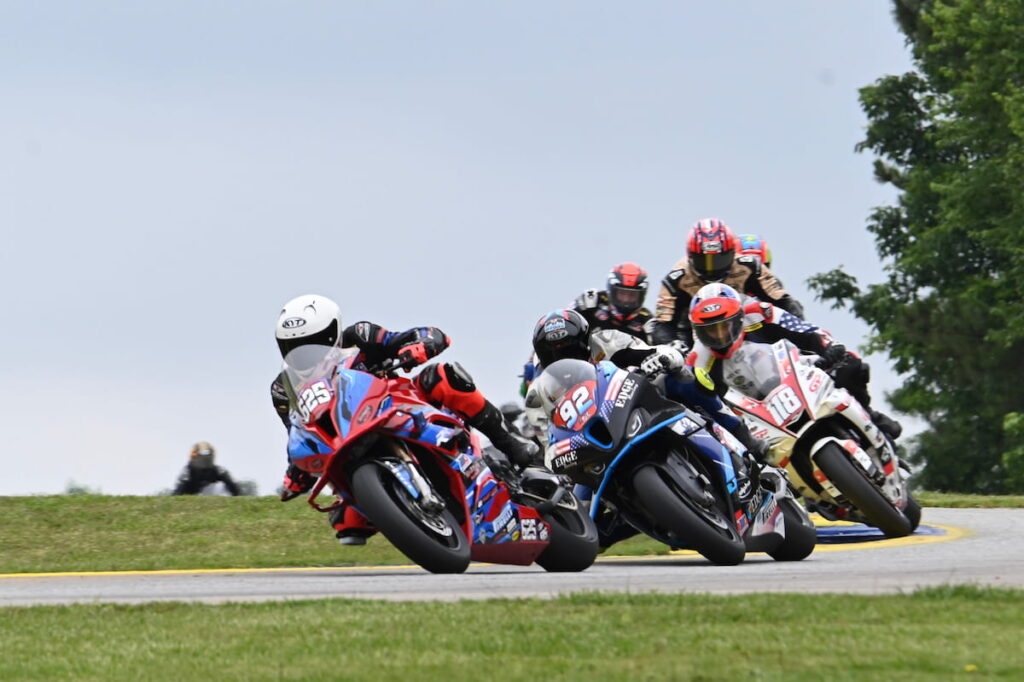
Photo by Nicole Paulich | Road Atlanta – MotoAmerica Stock 1000, Round 1. Threading the kink between Turns 3 and 4 with Jason Waters (#92) and Dylan Yelton (#118)
On paper, it doesn’t look like a MotoAmerica Superbike story.
Chris Durbin lives in Taylorsville, Kentucky – a small town about half an hour outside Louisville. He and his dad both work full-time at Ford’s Kentucky Truck Plant, building trucks all week and trying to build a superbike program on the edges of that schedule. He hauls a camper with the bike in the back, burns close to a grand in fuel some weekends, and still has to clock in on Monday.
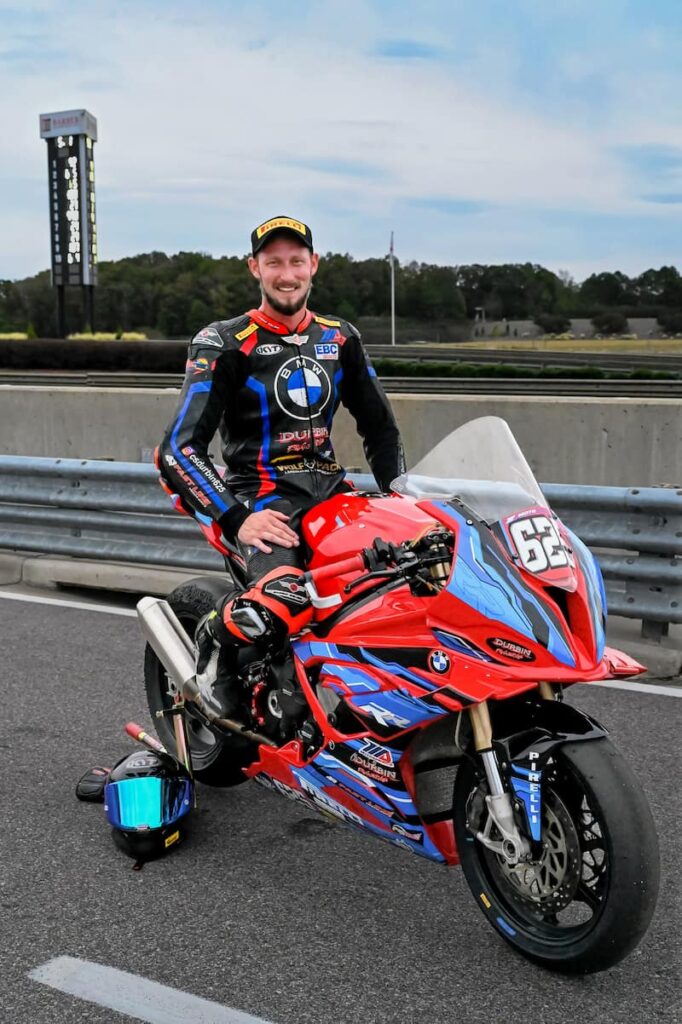
But if you catch him in the paddock, the picture changes. You’ll see a BMW prepped for the Superbike Cup, his dad flying in just to make race day, a friend who crossed the country with him last season, and a simple idea written across the bodywork:
Twenty dollars is twenty dollars.
That line became the backbone of his 2026 season: an invitation for everyday riders and fans to put their name on the bike and help a factory worker chase a superbike program.
We’re not cutting safety, and we’re not cutting maintenance. Those two go together. You don’t want something breaking at 190 miles an hour.
From Dirt Bikes and a Hayabusa to WERA National Champion
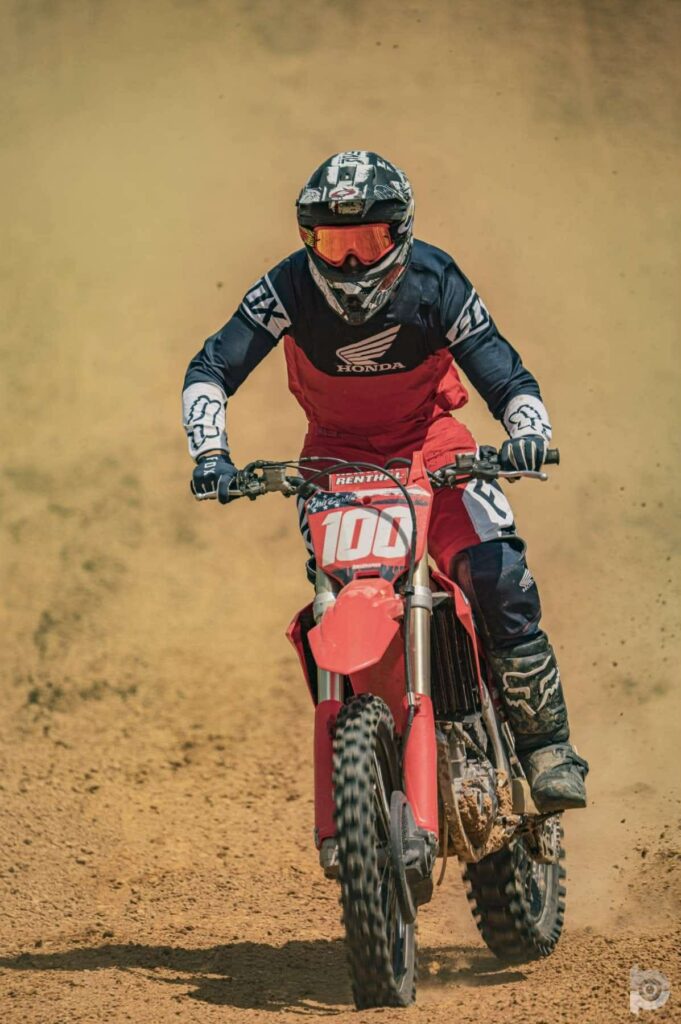
Racing showed up early for Chris. He started on dirt bikes at five years old, stacking wins and injuries through his teenage years before stepping away around eighteen. Life got serious. Work took over.
Photo by Brandon Potts
Somewhere in that gap he bought his first streetbike: a Suzuki Hayabusa. Not exactly a beginner or track-day bike. The learning curve was steep enough that he eventually blew it up, but it woke something up in him that never really went away.
Not long after, he stumbled into an incredible deal on a BMW S1000RR. That bike changed everything. He started riding with intent, chasing lap time instead of speed limits, and every ride turned into a lesson.
His first track day was only about five years ago. He spent one year doing track days, then jumped into racing. Now he’s sitting on four seasons of racing experience, and as of 2025 he’s the reigning WERA Superbike and Superstock National Champion. He also just wrapped his first full MotoAmerica season with consistent 6th–11th-place finishes and only one DNF.
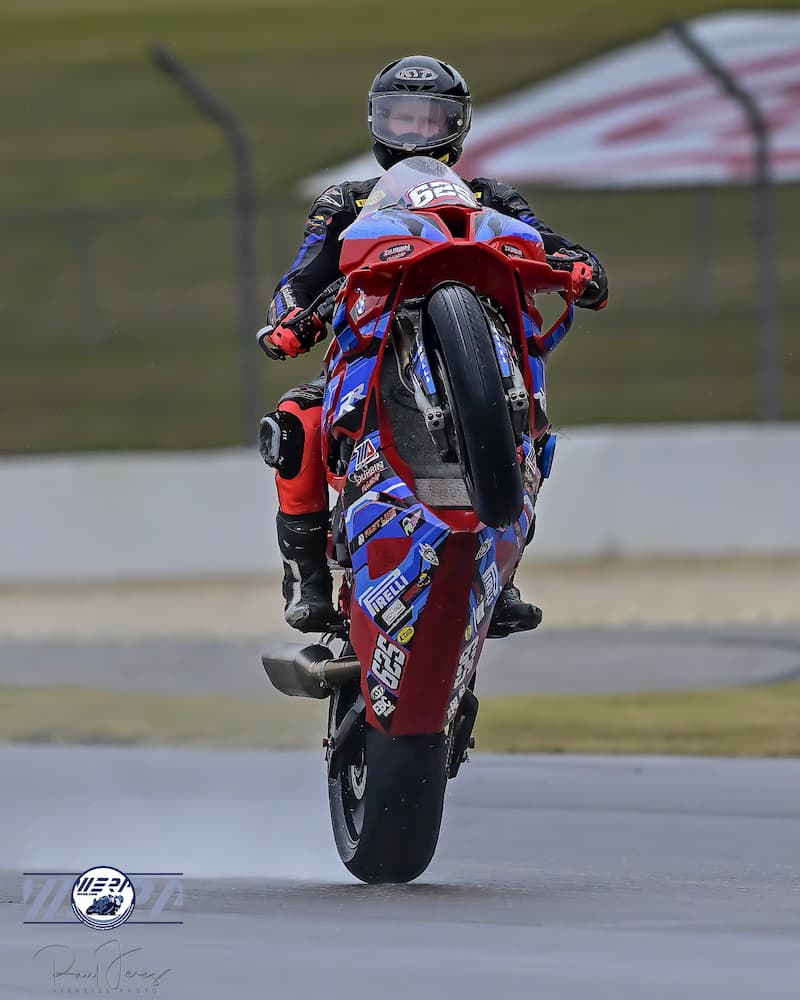
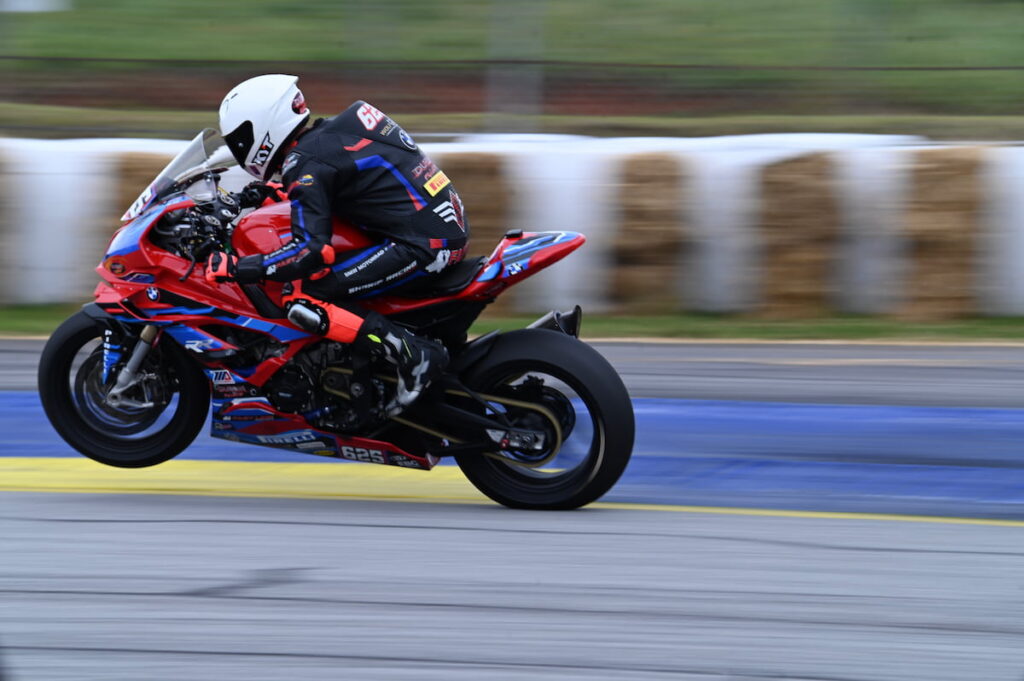
Photo by Raul Jerez, HighsidePhoto | WERA Grand National Finals 2025. Winner-take-all showdown with Jason Waters in the rain – this wheelie was the celebration after a nonstop scrap for the championship.
When Stock 1000 Vanishes Overnight
The original plan for 2026 was simple: run MotoAmerica’s Stock 1000 class and build from there.
Then the class disappeared.
“We had to shake things up when they got rid of Stock 1000,” he says. “The goal was to race that this year, then that disappeared. Now we’re doing Superbike – the Superbike Cup specifically.”
For Chris, Superbike Cup means lining up his Stock 1000-spec BMW in the Superbike class, in a field where the budgets, bikes, and teams are all a level up.
“The budgets are bigger, the bikes are built out more, the teams are stronger, and everyone’s talent is a notch above,” Chris says. “I’m shooting for top tens. That’s the target.”
The Hidden Cost of Just Showing Up
Fans see a few laps on TV. They don’t see the week wrapped around it.
For Chris, a typical MotoAmerica round looks like this: finish a shift at the plant, leave Wednesday night, drive through the dark, roll into the track Thursday morning, unload, set up the paddock, get through tech, and race all weekend. As soon as the last race is done, it’s another overnight haul back to Kentucky so he can clock in by 6:00 a.m. Monday. When his dad makes the trip, they trade driving shifts just to survive it.
“The big thing people don’t see is time,” he says. “You’re usually getting to the track two days before racing even starts. You can end up missing a week of work for one round.”
On the money side, a typical WERA club weekend for his program lands around $3,000 to $3,500. Fuel can hit about $1,000 if they’re traveling far. Tires add roughly $2,000. Food and everything else lives in the last few hundred dollars, assuming nothing breaks.
MotoAmerica weekends run closer to $6,000. Tires are a huge part of that. Whatever tire deals you might have at the club level don’t apply there. You buy the spec tires, every set, and each one is stickered and scanned to your team.
“The top teams will do half a qualifying session, come in, put a new set on, and chase a lap time,” he says. “They’ll burn through a few sets just in qualifying. Me? I get one set, learn the feel, and make it work.”
He also tries to stay on the East Coast as much as possible. Driving across the country and being back on the line at 6:00 a.m. Monday just isn’t realistic.

When someone’s name is on the bike, I want them to feel like they’re on the grid with us. It’s not just my program at that point – it’s ours.
The $20 Name-On-The-Bike Idea
The idea that’s now carrying his season started as a throwaway line.
“You know how people say, ‘Twenty dollars is twenty dollars?’” Chris says. “That line stuck in my head.”
He kept turning it over. Most fans don’t have the budget to write a big sponsorship check, but a lot of them would love to feel like they’re actually part of a program. At some point he caught himself thinking: I’d pay $20 to put my name on Toprak’s bike. Then the next thought came right behind it.
Maybe someone would feel that way about his.
The idea is simple: for twenty bucks, you can put a name on Chris’s bike. Your name, your kid’s name, a friend’s name – whatever matters to you. Enough of those $20 commitments start covering real line items: fuel, tires, entries.
And it’s not just numbers.
“I’d love to have all those names ghosted into the background of the fairings with the main sponsor logos over the top,” he says. “I think it would look awesome. And for everybody whose name is on the bike, they feel like they’re part of it. They’re more likely to make time to watch the live stream and follow along because they’re literally on the bike.”
Underneath it is a simple honesty: he’s not pretending to be a big-budget operation. He’s a factory worker trying to run a Superbike Cup program on factory money.
“I want people to feel inspired – like they’re helping someone chase a dream that feels almost out of reach for an average person,” he says. “It takes a lot of hours and hard work just to make it to the track. So if someone’s name is on my bike, I want them to feel like they’re part of the team.”
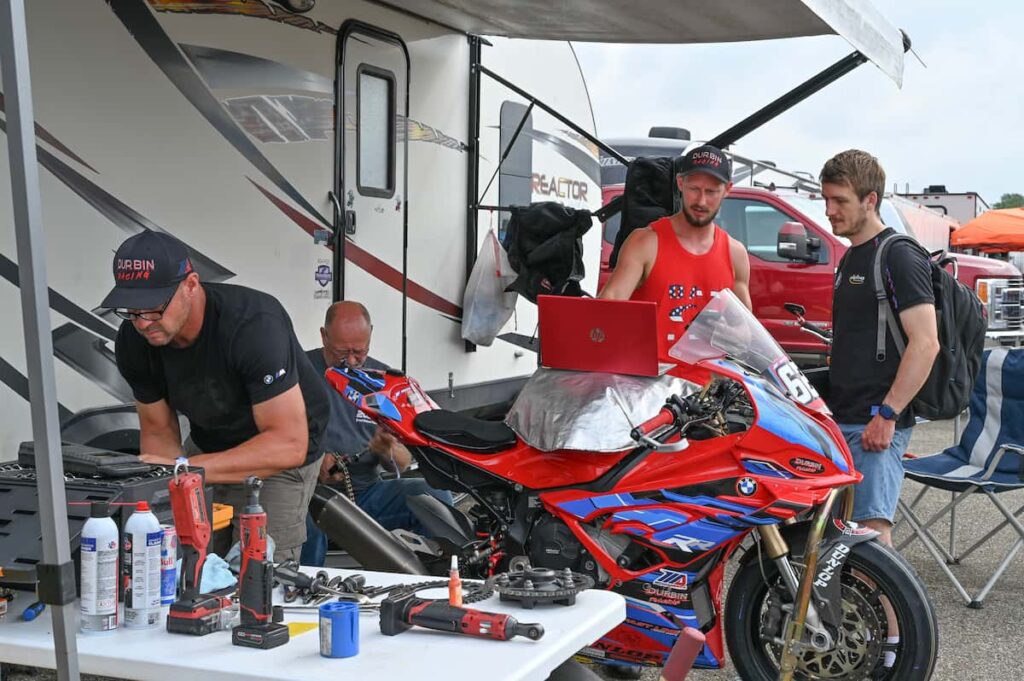
Photo by Nicole Paulich | MotoAmerica Road America, Stock 1000 Round 2 – Doug Durbin as the crew chief, Tobias Anderson as assistant crew chief, with Julian from ALPHA Racing in the box.
What Gets Cut - and What Never Does
When the spreadsheet goes red, something has to give. Chris is clear about what doesn’t move.
“We’re not cutting safety, and we’re not cutting maintenance,” he says. “Those two go together. You don’t want something breaking at 190 miles an hour. That’s non-negotiable.”
So he cuts somewhere else.
“What I’ll cut is the tire budget. I’ll run tires longer than I’d like and use them for practice. If you can go fast on a tire that’s moving around and sliding, then you put a fresh tire on and make it do the same thing, you’re going to be going a lot faster.”
That’s his personal line, not a universal prescription.
TrackDNA safety note: Chris is describing his own approach as an experienced racer with his team and support structure. TrackDNA isn’t telling riders to run tires past what their organization, tire vendor, or coach considers safe. Always follow your track org’s rules, tire guidelines, and your coach’s advice. If in doubt, prioritize safety and change the tire.
The short version: the tires might get stretched. The safety checks don’t.
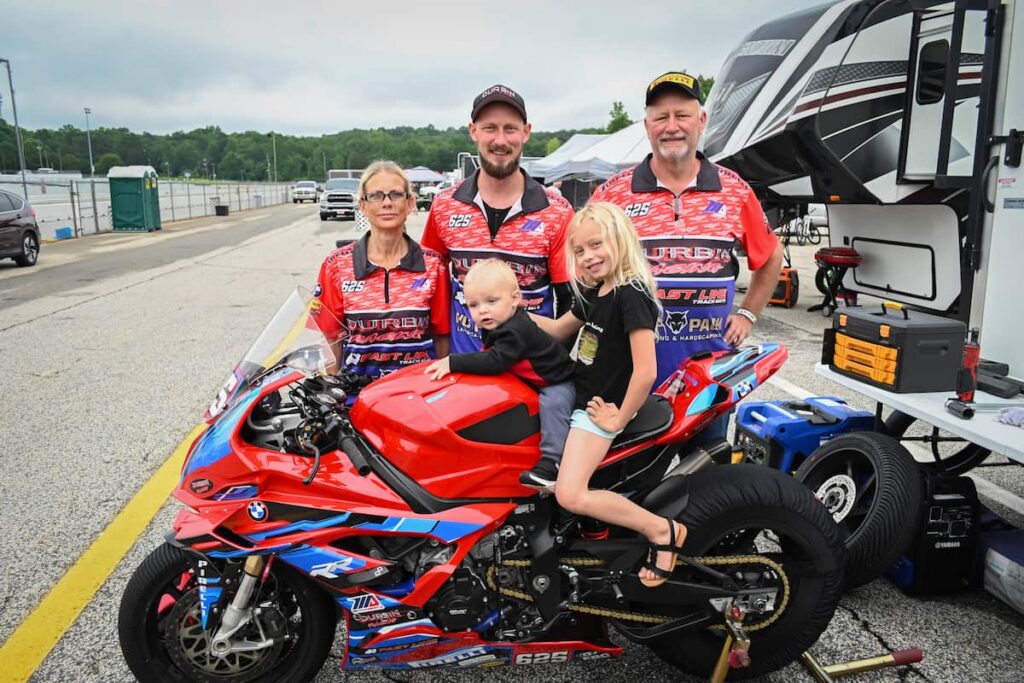
Photo by Nicole Paulich | WERA Cycle Jam at Road Atlanta with the whole Durbin crew – Sarina and Doug (mom and dad) and the kids, Lori and Ryder.
Wrecked Bikes, Two-Person Crew
Nobody pulls this off alone, but in Chris’s case “crew” is literally family.
“My dad is number one,” he says. “He goes to everything with me. If I have to leave before he can, he’ll fly in and meet me at the track. He’s flown in just to make it by race day and help.”
Every racebike in their program started life as a newer wrecked street bike bought at auction. Father and son strip them, rebuild them, and turn them into race bikes in the garage. They handle all the maintenance, fabrication, and setup themselves: gearing, wheelbase, ride height, springs, basic chassis changes. There’s no semi and no big staff. It’s just the two of them learning from the paddock and turning that into small gains.
There’s help, though. One of the quiet pillars is BMW engineer Steve Weir, who supports them through the BMW program. Chris gets full-spec setups and custom engine tuning for each track, with a map and baseline ready before he even rolls out of the pits.
They also work closely with ALPHA Racing, trading data and setup notes with other BMW riders who are chasing the same last tenths. And for the past two years, Fast Line Track Days has helped keep the wheels turning with track time and a paddock that feels like home. 2026 will be their third season together.
Away from the track, Chris is a father of two, and he has no doubt they’ll be future racers themselves.
All of that sits on top of the same obstacle: logistics. A Superbike program means more rounds than a Stock 1000 season and more miles between them.
“Logistics is the hardest part,” he says. “I think we’re looking at twenty races total. That’s the hardest part – figuring out how to get to every round and still make it back to work.”
Photo by Nicole Paulich | Road Atlanta, MotoAmerica Stock 1000, Round 1 – Turn 5 over the top of the hill, fighting the front wheel all the way over the crest.
Learning New Tracks and Holding the Line
Last season, three of the tracks on Chris’s calendar were completely new to him. There’s no private test; you learn at race pace.
“For me, one of the most important things is brake markers and reference points,” he says. “When you’re learning a new track and trying to get faster, you’ve got to push your braking deeper and deeper – but you need a system.”
His system is simple. Pick a clear reference point. Brake there until it’s comfortable. Then move it a little at a time.
“You find a reference point, then move it maybe ten feet at a time as you build comfort,” he says. “You don’t suddenly brake a hundred feet later – that’s bad news. Just keep it controlled and keep your eyes locked onto your markers.”
It’s the same mindset he brings to the season: small, repeatable steps instead of one big send.
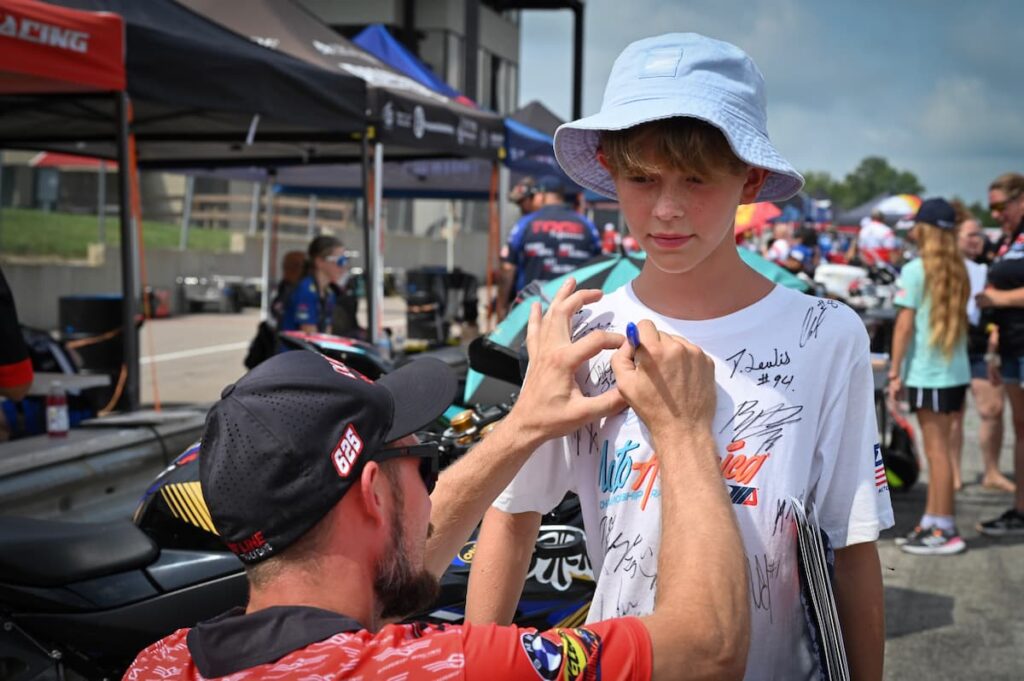
MotoAmerica Stock 1000 at Mid-Ohio – signing autographs for fans before the race.
Holding Up Physically and Mentally
If you work a full-time factory job and chase a national series on the side, your body becomes part of the program.
“I’m in the gym four to five days a week, usually multiple times a day,” he says. “We’ve got a gym at my job, so instead of taking normal breaks, I go train. Then after work, I’ll hit the gym again for an hour or two.”
The goal is simple: stay durable enough to keep doing this.
Mentally, he doesn’t overcomplicate it.
“I enjoy the adrenaline, the feeling of being locked in, and the level of challenge,” he says. “I don’t spend much time thinking about the negative things that could happen. I focus on doing what I know I should do to keep those things from happening. If I do my job – hit my markers, ride clean, respect the limits – that’s my mental prep.”
Ask him about routine and he’ll give you something every track-day rider recognizes.
“You’ve got to drink a Red Bull and you’ve got to check tire pressures,” he says. “Those two go hand in hand.”
Mistakes You Don’t Want on Live TV
Chris isn’t trying to sell a flawless story.
“I jump-started twice this year,” he says. “On live TV.”
The first time, a clutch cable broke. The second time was on him. Restart, nerves, left early.
“So yeah. No more jump starts.”
It’s the mix of honesty and self-awareness that makes him sound less like a press release and more like the guy pitted three spots down from you.
Photo by Nicole Paulich | WERA Grand National Finals 2025, just after securing the national championship.
Why He Still Shows Up - And How To Find Your Name On His Bike
When you ask why he keeps doing this, the answer isn’t complicated.
“Things are always hard,” he says. “That part isn’t new for me. You just keep pushing and see what tomorrow brings.”
The full MotoAmerica calendar might not happen. West Coast rounds are brutal on both budget and vacation days. The plan is to hit as many as the money and schedule allow.
Chris is quick to point out that none of this happens in a vacuum. For 2026 he’s backed by KYT Helmets, Fast Line Track Days, EBC Brakes, Steve Weir, ALPHA Racing, Auburndale Motors, Wolfpack Hardscaping, and Pirelli Tires.
What he wants, more than anything, is for people who put their name on the bike to feel like they’re actually in it with him.
“When someone’s name is on the bike, I want them to feel like they’re on the grid with us,” he says. “They’re the reason we can buy fuel, pay for tires, take the time off work. It’s not just my program at that point – it’s ours. It really does take a village to keep it rolling.”
And if you see him in the paddock?
“If you see me at the track, feel free to walk up and say hi,” Chris says. “I’m not intimidating. I like talking to everybody. Come by, check out the bike, and find your name if it’s on there.”
That’s the whole point of the $20 idea: not just to keep a superbike program alive, but to write the people who made it possible directly into the story.
Get the Inside Line
Real stories, track insights, and paddock moments — straight from riders who live it. No noise, no fluff, just the DNA of the track delivered to your inbox.
Author
-
Sean studied in Southeast Asia, did his stretch in corporate America as a Chief Revenue Officer, and then traded boardrooms for pit lanes. He’s a published author, and these days he’s on the grid with CMRA - on his way to MotoAmerica - and behind the scenes as the slightly obsessed human building TrackDNA, a magazine for riders who care as much about the culture and craft as they do about lap times.
Recent Posts